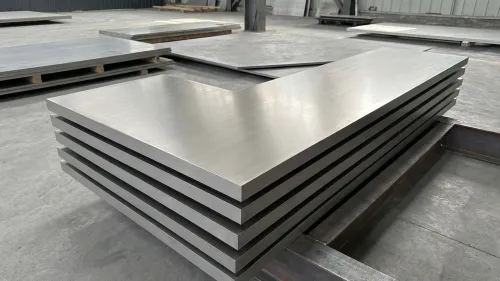
Titanium Polishing & Mechanical Surface Finishing
“Polishing” is often used as a catch-all, but mechanical polishing, brushing, matte blasting and deburring are different processes with different equipment, different consumables and different results. Specifying the wrong one means paying for a finish that does not suit the part.
This page covers mechanical finishing. Chemical processes — pickling and alpha-case removal — are a separate discipline: see descaling and pickling requirements when the part has been hot worked or heat treated.
Finish Types
| Finish | What it is | Typically used for |
|---|---|---|
| Mechanical polishing | Progressive abrasive stages to a smooth, reflective face | Fluid-contact surfaces, decorative parts, components where surface roughness affects performance |
| Brushing (satin / hairline) | Directional abrasive texture, consistent grain direction | Architectural and visible surfaces, panels, trim |
| Matte / bead blasting | Uniform low-gloss texture from blast media | Non-reflective surfaces, pre-treatment before coating or anodising |
| Deburring & edge finishing | Removal of burrs, edge breaking, radiusing | Cut and machined parts before assembly, handling safety, fatigue-sensitive edges |
Surface roughness (Ra) is agreed per order, together with the measurement direction and sampling length — an Ra figure without those two is not a specification.
Titanium-Specific Controls
Titanium is not stainless steel, and two points matter more here than in general metal finishing:
- No ferrous media, ever. Iron particles embedded in a titanium surface become corrosion initiation sites and will fail a pickling or passivation check later. Abrasives, belts, wheels and blast media are titanium-dedicated; blasting uses alumina, glass bead or ceramic, never steel shot or grit that has been used on carbon steel.
- Titanium dust is combustible. Fine particles from dry grinding, polishing and blasting are a recognised combustible-metal dust hazard. Extraction, collection and housekeeping for titanium must be separate from ferrous dry collection systems — this is a real constraint on where the work can be placed, not a formality.
Where the part has been hot worked, heat treated or pickled beforehand, mechanical finishing does not substitute for verifying alpha case removal and hydrogen content — polishing changes the surface appearance without changing what is underneath it.
What to Specify
To quote a finish rather than guess at one, we need:
- Target Ra (and whether it applies to the whole part or named surfaces)
- Finish type — polished, brushed, matte, or deburr only
- Direction, for brushed finishes
- What happens next — coating, anodising, welding, or final assembly
- Whether the part is a fluid-contact, medical or high-cleanliness item, which changes handling and packaging
If you are unsure which finish suits the application, describe the function of the surface and we will propose one rather than quoting the most expensive option by default.