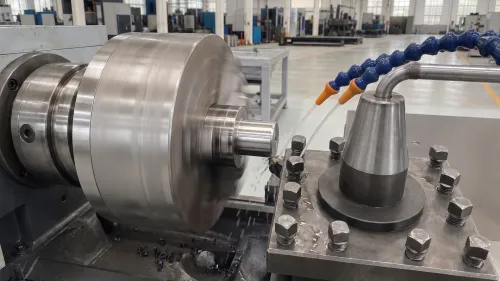
Titanium CNC Machining — From Bar Stock to Finished Component
We provide end-to-end titanium CNC machining — from raw bar/plate/forging supply through 5-axis precision machining to finished components with full documentation. Work is placed with qualified titanium-specialist manufacturing resources in Baoji, China’s titanium valley, and covers aerospace, medical, chemical, and marine applications.
Titanium Seller is the single contracting party. However many processing stages or facilities an order passes through, quality, lead time, documentation and claims remain our responsibility — you deal with one contract, one quality agreement and one point of contact.
Typical turnaround: 10–25 working days from PO to shipment, depending on complexity and quantity.
What We Machine
| Capability | Range | Typical Tolerance |
|---|---|---|
| 3-axis milling | Up to 1,200 × 600 × 500 mm | ±0.05 mm |
| 5-axis milling | Up to 800 × 600 × 400 mm | ±0.02 mm |
| CNC turning | Ø1–Ø250 mm × 1,500 mm length | ±0.01 mm |
| Wire EDM | Up to 600 × 400 mm, 300 mm Z | ±0.01 mm |
| Surface grinding | Ra 0.4 μm | ±0.01 mm |
Grades machined daily: Grade 2 (CP), Grade 5 (Ti-6Al-4V), Grade 9 (Ti-3Al-2.5V), Grade 23 (Ti-6Al-4V ELI), TA15, TC4, TC11.
Titanium Milling
Milling covers most of our titanium work — pockets, faces, contours, thin webs and 5-axis surfaces on brackets, housings and manifolds. Two things are worth knowing before you compare quotes:
- Titanium is not a high material-removal-rate metal. Its low thermal conductivity keeps heat in the cutting zone, so titanium runs at roughly a third of the cutting speed used on steel. Anyone quoting titanium milling on steel-like cycle times has not costed the job properly.
- Thin walls and deep pockets drive the price more than the material does. Wall thickness below about 1 mm, deep pockets and long unsupported features require step-down strategies and extra fixturing, which shows up in setup rather than in kilograms of stock.
Send the model and we will tell you where the cost actually sits before you commit.
Why Titanium Machining Is Different
Titanium isn’t stainless steel. Get it wrong and you’ll see:
- Tool wear 5–10× faster than steel. Titanium’s low thermal conductivity concentrates heat at the cutting edge.
- Galling and built-up edge. Titanium chemically reacts with most carbide tools above 600°C, requiring specific coatings (AlTiN, TiAlN).
- Springback. Ti-6Al-4V’s elastic modulus (110 GPa) is half of steel’s, causing dimensional drift if feed rates are wrong.
- Fire risk. Fine titanium chips are pyrophoric. Coolant flood and chip evacuation are not optional.
We place titanium work only with dedicated titanium manufacturing resources — not with general job shops that “also” run titanium. Process route, tooling strategy and inspection plan are agreed before the order is released.
Process Parameters We Use
For Ti-6Al-4V (Grade 5), our baseline machining envelope:
- Cutting speed (Vc): 30–60 m/min for finishing, 20–40 m/min for roughing
- Feed (fz): 0.05–0.15 mm/tooth
- Depth of cut (ap): Up to 0.4 × tool diameter for finishing
- Coolant: High-pressure (≥40 bar) flood with synthetic coolant
- Tool material: Ungrooved AlTiN-coated carbide for roughing, PCD for finishing
These are conservative starting points. Actual parameters are tuned per geometry and tool path strategy.
Certification & Documentation
Every shipment includes:
- Material Test Certificate (EN 10204 Type 3.1) with chemistry and mechanical results
- Dimensional inspection report (CMM-based for critical features)
- Heat number traceability from ingot pour through finished part
- Optional: Type 3.2 third-party witnessed inspection for aerospace/medical work
On certification: required approvals (aerospace, medical, oil & gas and special-process schemes) are confirmed per order against the actual executing facility — certificate number, scope, address and validity date. We state the applicable approvals in the quotation for your specific part, rather than listing scheme names here, because such approvals are issued to a named site for a named process and never transfer across facilities.
Pricing & MOQ
| Order Size | Typical Pricing |
|---|---|
| 1–10 pieces (prototype) | Hourly + setup, ~$120–280/hour |
| 10–100 pieces (small batch) | Per-piece quoted with setup amortized |
| 100+ pieces (production) | Volume pricing, MTC + dimensional report included |
No minimum order. We frequently produce 1–5 piece prototypes for engineering validation.
For pricing visibility before you commit, see our titanium price guide — material cost is typically 35–55% of finished part cost.
Common Applications
- Aerospace: Brackets, fittings, fasteners, manifolds, engine ducting
- Medical: Orthopedic instruments, dental components, surgical tools
- Chemical: Heat exchanger tube sheets, pump impellers, valve bodies
- Marine: Propeller shafts, seawater piping fittings
- Motorsport: Connecting rods, exhaust components, fasteners
Get a Machining Quote
Send us:
- STEP/IGES drawing (preferred) or PDF dimensioned print
- Quantity required
- Material grade preference (or we’ll recommend)
- Surface finish & tolerances beyond drawing defaults
- Certification needs (MTC type, third-party inspection)
We respond with pricing, lead time, and any DFM suggestions within 24 hours.