Type something to search...

Hamr

others
IperionX's 24/7 Powder Ramp Shows Why Recycled Titanium Still Needs a Qualification Chain
By Jason/ On 08 May, 2026

IperionX's 24/7 Powder Ramp Shows Why Recycled Titanium Still Needs a Qualification Chain

IperionX's move to continuous titanium powder production is a real supply-chain signal, but not because output tonnage alone changes the market. For buyers of titanium powder, fasteners, brackets, plates, bars or custom components, the bigger question is whether a recycled titanium route can carry enough evidence from scrap feedstock to approved product form.Metal AM reported on May 6 that IperionX's Virginia Titanium Manufacturing Campus had moved to 24/7 production during the quarter ended March 31, 2026, with all HAMR powder production systems commissioned and in ramp-up. IperionX's March 2026 quarterly report said powder output reached about 4.2 metric tons in March, equal to roughly 50 tpa annualized at an early-stage ramp rate, and that the company was targeting about 200 tpa of titanium powder run-rate capacity by the end of 2026. The same report matters because it links powder to downstream products. IperionX said powder metallurgy scale-up continued during the quarter, including a 100-ton uniaxial press, a cold isostatic press for larger-format titanium components, a six-axis 300-ton SACMI powder metallurgy press, additional sintering furnaces and binder-jet additive manufacturing capability. The company framed these systems as part of the path from powder output toward higher-volume titanium powder-to-part manufacturing and customer qualification. That is where the industrial story sits. A powder plant can run around the clock and still be early in commercial qualification. Buyers do not only buy powder. They buy a route that must survive material review, process validation, inspection and application approval. Why Scrap-to-Powder Is a Supply-Chain Question The U.S. Geological Survey's 2026 titanium summary said the United States did not produce titanium sponge metal in 2025 and estimated net import reliance for titanium sponge at 100%. USGS also reported estimated 2025 sponge imports of 44,000 tons and noted that U.S. producers of ingot and downstream products remained reliant on imported sponge and scrap. In that context, a recycled titanium powder route is strategically interesting. It offers a way to convert scrap into powder and then into manufactured products without treating imported sponge as the only starting point. IperionX said in January that the U.S. Government had transferred about 290 metric tons of high-quality Ti64 scrap to the company and obligated the final US$4.6 million under a US$47.1 million award supporting titanium supply-chain scale-up. But scrap-to-powder is not automatically scrap-to-approved-part. The value is created only if the feedstock record, powder properties, forming route and final inspection package remain connected. The Buyer Framework: From Scrap to Approved Part For buyers evaluating recycled titanium powder or powder-derived products, the practical framework is:Evidence gate What buyers should verify Why it mattersFeedstock provenance Scrap source, alloy identity, contamination controls and segregation Recycled titanium only works when the starting material is traceablePowder specification Chemistry, oxygen level, particle size, morphology, flowability and lot consistency Powder behavior affects pressing, sintering, AM and final propertiesProcess route HAMR, powder metallurgy, press-sinter-forge, binder jet or other consolidation path Different routes produce different density, microstructure and geometry limitsDownstream capacity Presses, sintering furnaces, finishing, machining and inspection availability Powder output is not the same as finished-product readinessInspection evidence Mechanical testing, dimensional checks, density, surface condition and nonconformance records Customers qualify evidence, not production claimsCustomer approval path Prototype, low-rate production, market entry timing and application-specific validation Qualification cycles differ by aerospace, medical, automotive, consumer and industrial marketsThis framework is more useful than asking whether a powder plant has reached a headline capacity number. Capacity matters, but qualification determines whether the material can enter a buyer's real supply chain. The same buyer logic appears in our parallel reads — the aerospace titanium procurement chain (five gates) and the medical titanium regulatory chain (six gates around FDA 510(k) and design control). Recycled-powder buyers face the same template, with feedstock-provenance and oxygen-control as the front-loaded risks. What This Means for Titanium Product Buyers For powder buyers, the first issue is repeatability. A recycled route must prove that powder chemistry, oxygen control and lot-to-lot consistency can stay inside the buyer's window. For powder metallurgy and sintered products, the next issue is consolidation. Density, dimensional control, surface condition and downstream machining can decide whether a part is commercially usable. For mill-product and engineered-product buyers, the question is slightly different. IperionX's own investor materials describe a range of possible outputs from powder into mill products, engineered products, fasteners, enclosures, brackets, impellers, actuators, gears, plates, bars, sheets and wire. That breadth is valuable only if each product form has its own qualification logic. A fastener buyer will not approve a route the same way an aerospace mill-product buyer approves plate or bar. An automotive bracket program will not move at the same pace as a consumer-electronics enclosure. The company's quarterly report makes the timing issue visible. It says production remains in ramp-up, downstream capacity is being installed and customer qualification timelines are expected to accelerate as bottlenecks are removed. That language should be read carefully. It is positive for supply-chain development, but it is not the same as broad commercial approval across all titanium product categories. The same caution applies to the TITAN-AM aerospace additive evidence chain — programme announcements move faster than qualified-supply approvals. What Suppliers Should Learn Suppliers working with titanium powder, recycled feedstock or powder-derived components should prepare to sell evidence before volume. A useful buyer package may include feedstock traceability, powder lot data, oxygen and chemistry records, powder handling controls, process-route descriptions, sintering or forging parameters, mechanical test results, inspection records and application-specific validation notes. The same lesson applies to export suppliers outside the powder business. If recycled or powder-derived titanium becomes more common, buyers of bars, plates, tubes, forgings and machined parts will ask where the material came from and how the route was controlled. A lower-cost or lower-carbon titanium story will not be enough if the customer cannot qualify the part. The defensible conclusion is that IperionX's 24/7 ramp is not just a production milestone. It is a test of whether recycled titanium can move from strategic supply-chain promise into qualification-ready products. The winners in that shift will not be the suppliers that only report tonnage. They will be the suppliers that make the route auditable from scrap to powder to approved part.Related Products & ServicesTitanium forgings — Gr.1/Gr.2/Gr.5/Gr.7/Gr.12, AMS 4928 / ASTM B381 channels Titanium bar / rod — ASTM B348 machining stock with batch traceability Titanium sheet & plate — ASTM B265 plate stock for chemical, marine and structural blanks Titanium wire — feedstock-grade wire for AM and welding routes Special titanium alloys — Gr.5 / Ti-6Al-4V and Gr.23 / Ti-6Al-4V ELI reference Titanium nuts & bolts / fasteners — for engineered and bracket applications Contract machining services — finish machining, dimensional verification, inspection-ready delivery Titanium industry news — ongoing tracking of qualification chains across aerospace, medical, chemical and powder routes

others
IperionX Hits 4.2 Tonnes in March on 24/7 Operations: From 1,400 tpa Math to Production Cadence
By Jason/ On 29 Apr, 2026

IperionX Hits 4.2 Tonnes in March on 24/7 Operations: From 1,400 tpa Math to Production Cadence

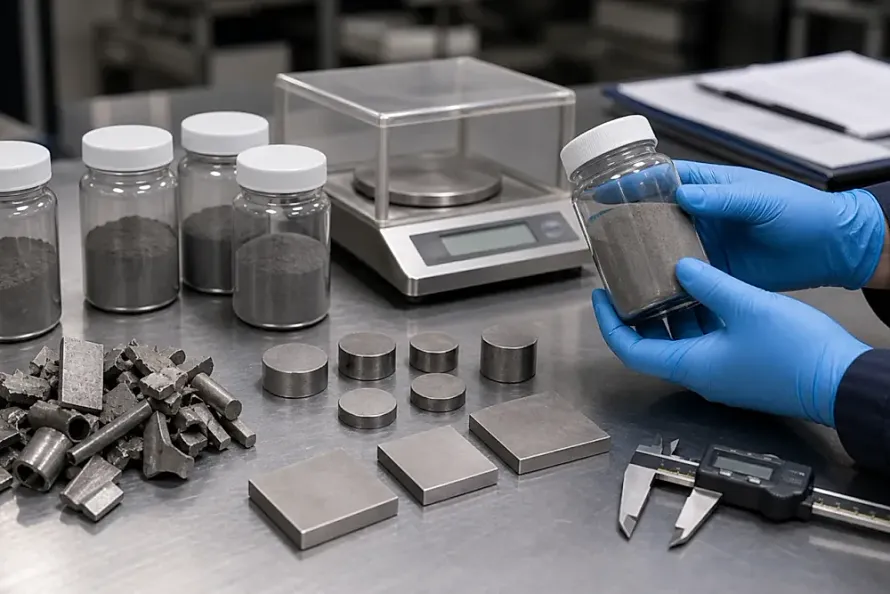
IperionX released its March 2026 quarterly on April 27. Buried under the headline volume figure is a number worth pulling apart: in March the Virginia plant produced 4.2 tonnes of HAMR (Hydrogen Assisted Metallothermic Reduction) titanium powder, putting annualized run-rate around 50 tpa, with a CY2026 year-end target of 200 tpa. The site has now shifted to 24/7 operation. Four days ago we worked through the math showing IperionX's 1,400 tpa would cover only 3.5% of the 40,000-tonne US shortfall — a long-run "patch, not foundation" verdict. Today's news cuts at the same company from the other side: whether the long-run math holds is one question; whether short-run execution cadence is on track is another. The 4.2 tonne figure tells us the second one is happening. What 4.2 tonnes per month actually meansSpread 4.2 tonnes across a month and you get 135 kg/day. For a titanium powder plant that is not a big number — Toho and Osaka push out sponge by the hundred tonnes per day, and the major Baoji powder lines run at tens of tonnes per month. But on the curve of US-domestic titanium powder going from zero to live, this is the first piece of physical evidence that line cadence has stabilized. Pulling out the specific numbers from the quarterly:Cash + committed funding: $48.2M cash + $42.1M of committed reimbursable government funding, plus the $47.1M IBAS award now landed Feedstock locked: 290 tonnes of free DoD scrap titanium transferred — at 200 tpa run-rate that is roughly 1.5 years of feedstock cover Equipment in place: 100-tonne single-axis press optimization complete, 300-tonne SACMI six-axis press installed, and the large-format cold isostatic press (CIP) is in operation Downstream orders: defense fastener line ramping; American Rheinmetall prototype order signed Optional funding path: the SBIR Phase III IDIQ channel runs up to $99MTake those five variables together and IperionX is in possession of the physical conditions to execute on plan through the second half of 2026 and into the first half of 2027. That doesn't contradict our four-day-old "1,400 tpa only covers 3.5%" line — execution-on-plan is line cadence, coverage gap is market structure. Both are true descriptions of the same project at different time horizons. HAMR and traditional Kroll: the product-line split is still clean What deserves spelling out is that IperionX's 4.2 tonnes of titanium powder is not aimed at displacing traditional VAR (Vacuum Arc Remelting) ingot. The HAMR process produces titanium powder or semi-finished alloy directly, and the downstream falls into three buckets: First, additive manufacturing — US defense fasteners, satellite structures, medical AM components. Second, powder metallurgy press parts — mid-size components where isotropy matters. Third, scrap closed-loop recycling — converting the 50,000-tonne stock of US titanium scrap back into usable feedstock. Aerospace large forgings — Boeing 787 spars, F-35 primary structure, Airbus A350 landing gear — still go through the traditional Kroll-route path: Kroll sponge → VAR double or triple melt → large ingot → forge. US-domestic capacity on that route is essentially zero, and supply still leans on Japan (Toho, Osaka), China (Baoti, Pangang, Western Superconducting), and the partly-functional VSMPO output that the EU sanctions keep waving past. In other words, what IperionX solves in 2026-2027 is the localization of the US AM titanium powder supply chain. It does not solve the localization of aerospace large forgings. That product-line distinction is the single thing buyers most often miss when reading IperionX coverage — HAMR is a complement to Kroll, not a replacement. What we see at the Titanium Valley endIn our Baoji (China's Titanium Valley) physical inventory system as of late April 2026:Titanium powder: spherical Ti-6Al-4V (TC4) / Gr.23 ELI in the 15-53 μm size band, roughly 800 kg in stock. Specification matches direct LPBF (Laser Powder Bed Fusion) / SLM print requirements Titanium wire: Φ1.0 / Φ1.2 / Φ1.6 / Φ2.0 / Φ2.4 mm, five diameters, roughly 1 tonne combined in stock. Matches the dominant feed-wire diameters for WAAM (Wire Arc Additive Manufacturing)That stock picture isn't large in absolute terms, but it is interesting against IperionX's 4.2-tonne/month reference. The US HAMR route is biased toward "non-spherical / direct-alloy" output, and spherical LPBF powder still depends on offshore supply. AM customers running qualification on spherical powder care about oxygen content (<0.13%), satellite particle ratio, and flowability — none of which has a fully equivalent US-domestic substitute through 2026-2027. Inquiry frequency from US and European AM customers has clearly increased this week. The inquiry profile has a common thread: small order, tight qualification. Typical sample batches run 200-500 kg, but each batch demands the full ICP chemistry report + particle size distribution (PSD) + Hall flow stack. That profile maps almost exactly onto IperionX's own early-customer profile, which suggests the same demand category is being served on both sides — only the geography differs. Checklist for buyers and materials engineers If you are planning titanium powder and wire procurement for late-2026 through mid-2027, three things to do right now: First, build separate qualified vendor lists for the HAMR route and the Kroll route. For the former, US-domestic supply via IperionX is the lead choice (US compliance priority); for the latter, you still need a stable feed from offshore Tier 1 mills. Run them as two separate tracks — don't conflate them. Second, lock "spherical powder PSD ≤53 μm + oxygen ≤0.13% + satellite particles ≤2%" into your RFQ template as a hard requirement. That is the entry threshold for direct LPBF/SLM print. The HAMR process route doesn't cover that sub-specification near-term. Third, settle stock vs futures separately. What we see across our titanium wire and powder lines is that customers who can pull physical sample material clear AM project qualification four to six weeks ahead of customers depending purely on futures supply. In the window before IperionX hits volume production, that is a real first-mover advantage. The variable worth tracking over the next 12 months is not whether IperionX hits its 200 tpa target — most likely it does — but how many Chinese and Japanese mills make it onto the US AM titanium powder qualified vendor lists. That curve determines what real share Asian powder mills hold in the US market post-2027. Related Products & ServicesService → No Minimum Order Quantity Sourcing — the 200-500 kg single-batch qualification channel for early-stage AM projects Product → Titanium Wires — Φ1.0-2.4 mm WAAM-grade titanium wire from stock, multi-grade Product → Special Titanium Alloys — Ti-6Al-4V / Gr.23 ELI spherical powder and matched AM grade stockAbout: Titanium Seller is a supply chain platform based in Baoji, China's Titanium Valley.

others
IperionX 1,400 tpa Covers 3.5% of the U.S. 40,000-Tonne Titanium Gap
By Jason/ On 25 Apr, 2026

IperionX 1,400 tpa Covers 3.5% of the U.S. 40,000-Tonne Titanium Gap

On April 26, IperionX announced commercial titanium production at its Virginia plant, with a Definitive Feasibility Study (DFS) due in Q2 2026 and a target run-rate of 1,400 tpa by mid-2027. BTIG put a Buy rating on the stock at a $40 price target; cumulative DoD support to IperionX now stands at $47.1 million; American Rheinmetall has placed prototype orders. The market narrative is "U.S. titanium sponge supply chain reshored." Run the capacity math, and the picture is more measured. This is a starting line, not an answer. Sizing the U.S. Titanium GapAfter Timet's Henderson, Nevada plant — the last U.S. primary sponge producer — went dark, domestic primary titanium sponge capacity fell to zero. Aerospace and defense net annual demand sits conservatively at 30,000–40,000 tpa, accounting for nearly 75% of total U.S. titanium consumption. That means the United States imports roughly 40,000 tpa of aerospace-grade sponge every year, primarily from Japan (Toho and Osaka), with a Russian (VSMPO) share that's been compressed below 20%. The shortfall has two layers. First, the volume gap: 40,000 tpa. Second, the process gap: large-diameter ingots for flight-critical parts can today only be produced through the conventional Kroll-sponge plus VAR-remelt route, and that capacity is still offshore. Any honest "U.S. titanium independence" conversation has to answer both layers separately. Where 1,400 tpa Actually Lands Drop 1,400 tpa back into the global picture. Total worldwide sponge capacity runs roughly 250,000–300,000 tpa today, putting IperionX at 0.4%–0.5%. Score it against the 40,000-tpa U.S. gap and the headline number is 3.5% coverage at full run-rate. That's a "pilot-to-commercial boutique" tier — set against VSMPO at 30,000–40,000+ tpa, Toho and Osaka at roughly 30,000–40,000 tpa each, and single-plant Chinese producers like Pangang, Shuangrui, and Baoti running anywhere from 10,000 tpa to several tens of thousands. 1,400 tpa is an incremental patch in that league, not the baseline. There's a process detail that matters. IperionX runs HAMR (Hydrogen Assisted Metallothermic Reduction), a route designed to bypass the energy intensity and environmental footprint of the Kroll process. HAMR yields titanium powder or semi-finished alloy directly — well-suited to additive manufacturing, powder metallurgy, and closed-loop scrap recovery. It is not the route you'd choose to melt several-tonne ingots for rolling into aerospace heavy plate. Put another way: 1,400 tpa is a patch in volume terms and a niche in process terms. It localizes powder, AM, and specialty parts. It does not localize aerospace heavy forgings. The Hard Constraint: Buy-to-Fly Ratio Push the math one layer deeper and the "3.5% coverage" headline overstates IperionX's contribution to the aerospace mainline. The reason is the inescapable constraint in aerospace manufacturing: the buy-to-fly ratio. Conventional forge-and-machine titanium parts run buy-to-fly from 8:1 to 10:1. Buy 10 tonnes of titanium and only 1 tonne actually flies — the other 9 tonnes leave the shop as chips and offcuts. Take the Boeing 787. Airframe titanium content is around 15% of structural weight, and combined with engine content, roughly 15–20 tonnes of titanium per aircraft actually goes airborne. Back-solving at 8:1 buy-to-fly, the front-end supply chain has to deliver 120–150 tonnes per ship. Which means IperionX at 1,400 tpa, on a conventional process route, supports front-end feedstock for roughly 10 Boeing 787s per year. Boeing, Lockheed (F-35 build rates run several hundred a year at peak), and the U.S. side of Airbus together run titanium throughput well above that figure. Additive manufacturing can take buy-to-fly down to 2:1 or even 1.5:1, and that is the genuine value of the IperionX process route. But AM share on flight-critical structures — wing spars, primary landing gear — is still under 5%. Buy-to-fly improvement is a long-cycle variable. In the 3–5 year window, 1,400 tpa serves non-primary structure and specialty parts, not the mainline. The View from the Titanium Valley: 1,400 tpa Doesn't Reset Procurement PlansWhat we see from Baoji — China's Titanium Valley — runs cooler than the market narrative. Over the past six months, inquiry frequency from U.S. aerospace Tier 2 forge shops and machining houses has not pulled back on the IperionX commissioning news. If anything, the inquiry mix has shifted as the VSMPO collapse and de-Russification compliance pressure compound. Ready-stock RFQs on Grade 5 bar and Ti-6Al-4V forged billet are gaining share, and rush-delivery (under four weeks to release) has climbed from under 15% a year ago to north of 30%. Our April peak ready-stock on aerospace Ti-6Al-4V billet and bar was 50 tonnes. That port-level signal says one thing clearly. Inside the procurement plans of industrial buyers, 1,400 tpa is not a "U.S. problem solved" signal. It's a "one of the long-term lanes has gone live" signal. Buyers are not pausing existing qualified-supplier expansion — they're accelerating multi-sourcing. A Talking-Points Toolkit for U.S. Buyers If you have to explain to a customer, board, or earnings audience why IperionX cannot carry the full U.S. aerospace ask, three data pairings do most of the work. Macro pairing: 1,400 tpa versus 30,000–40,000 tpa of annual U.S. aerospace and defense net demand — full-rate coverage 3.5%–4.7%. Micro pairing: 1,400 tpa versus 120–150 tonnes of front-end feedstock per Boeing 787 — roughly 10 ships at standard buy-to-fly. Process pairing: HAMR powder and AM parts versus VAR-melted heavy ingot — the former is the right route for powder metallurgy, the latter is the working path for flight-critical forgings. Together, those three pairings tell a more accurate story than the reshoring headline. IperionX is a meaningful add to U.S. titanium supply diversification, not a substitute. U.S. buyers procuring aerospace titanium between 2026 and 2030 will still walk on three legs: Japan as primary, China as growth, and U.S. domestic (IperionX and other powder lines) as specialty. Availability of large-section forgings on titanium bar and titanium plate still hinges on conventional VAR melt capacity. What This Means For procurement directors: treat IperionX as the AM-parts reshoring lane, not the heavy-forgings off-shore-exit lane. Run qualification on separate tracks. For shop-floor operations: HAMR diffusion will pull titanium powder demand into a new structural tier, but it does not replace conventional Kroll aerospace sponge demand. The two lines will run in parallel for a long time. See our read on the titanium powder market in 2026 for the full picture. For project finance: write the 3.5% number into the 2027–2030 supply chain risk matrix. It captures how slowly the reshoring story actually moves compared to the press releases. Related Products & ServicesService → No Minimum Order Quantity Sourcing — sample and trial-batch qualification channel for early-stage multi-sourcing Product → Ti-6Al-4V Titanium Bar — aerospace Grade 5 bar and forged billet, VAR melted, heat-number traceable Product → Titanium Sheets and Plates — large-format Ti-6Al-4V plate, feedstock for flight-critical forgingsAbout: Titanium Seller is a supply chain platform based in Baoji, China's Titanium Valley.

Ready to Start Your Project?

Get factory-direct pricing on titanium products. No minimum order.

Get a Free Quote
Quick Inquiry