Type something to search...

Titanium tube

Manufacturing and Technology
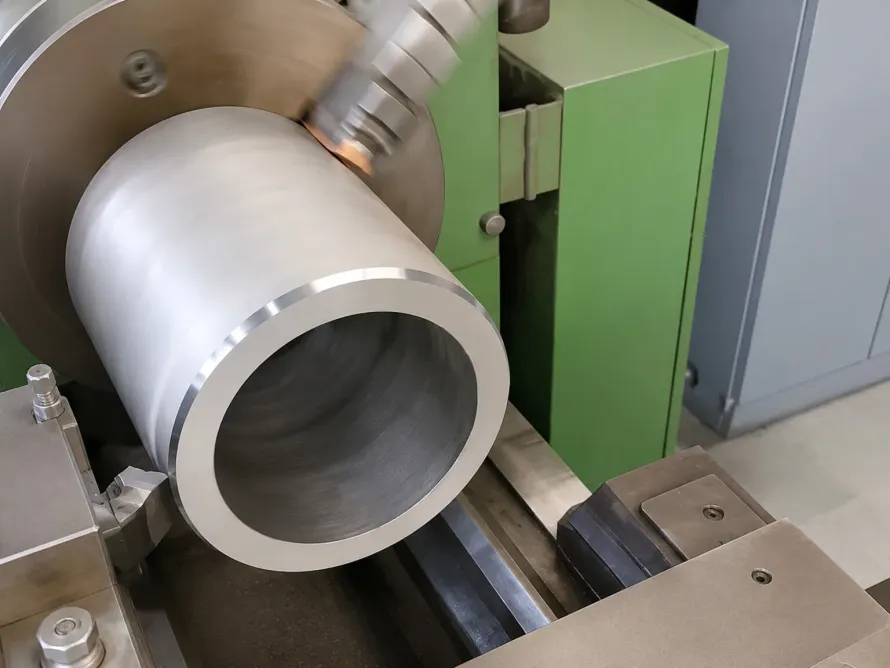
Representative large titanium tube machining illustrates dimensional control; it is not the CERN HiLumi LHC beam-dump vessel.
By Jason/ On 25 Jul, 2026

CERN’s 450°C Trial Reframes Precision Titanium Tube Buying

CERN’s successful shrink-fitting trial for the High-Luminosity Large Hadron Collider beam dumps is a compact lesson in precision titanium manufacturing. A 12 mm-thick titanium vessel, 700 mm in diameter, had to be heated to 450°C and lowered over a stack of carbon-fibre-reinforced carbon plates. Heating created only about 1 mm of clearance. Component tolerance windows were 0.1 mm, and the operation had to finish in under five minutes before cooling and contraction made the fit too risky. This is not a general recipe for every titanium tube. It is a clear demonstration that a thermal-fit component cannot be purchased through a room-temperature dimension table alone.The Trial Validated An Assembly Process, Not Just A Part In its June 17 project update, CERN said the trial was the final crucial milestone in validating the beam-dump assembly process. At room temperature, the carbon-fibre-reinforced carbon plates are larger than the vessel’s internal space. The heated titanium expands enough to pass over the stack; as it cools, the parts press together to provide mechanical hold and thermal contact. Too little interference could allow contact to be lost and plates to slide during a beam-dump event. Too much interference could make assembly impossible. CERN therefore had to specify, achieve and verify a narrow dimensional population across both mating components. The trial also joined material protection to production timing. CERN assessed the maximum temperature to preserve the vessel’s mechanical properties while minimizing oxidation. Dedicated tooling controlled the plate stack, and repeated tests reduced the total operation below the five-minute limit. Series-production assemblies were scheduled to start in September. That combination is the real news: the accepted product is the tube, mating stack, heat cycle, tooling, handling sequence and inspection record working as one controlled route. Five Windows Must Overlap A shrink fit succeeds only when five windows remain open at the same time:Control window Key question Release evidenceDimensional Do actual inside and outside dimensions create the intended room-temperature interference? Mapped diameter, roundness, wall, straightness and mating-component results with measurement uncertaintyThermal Does the defined temperature and uniformity create adequate expansion without unacceptable property or surface change? Qualified heat cycle, sensor locations, calibration, uniformity record and material assessmentTime Can transfer, alignment and lowering finish before contraction closes the clearance? Timed work instruction, rehearsal data, hold points and abort ruleSurface Are oxidation, contamination, burrs and contact surfaces controlled through heating and assembly? Preheat condition, atmosphere or exposure limits, cleanliness record and post-fit surface inspectionRelease Did the actual assembly achieve seating, contact and integrity without hidden damage? Travel or position record, final dimensions, visual/NDT checks where required and serialized genealogyThe five-window method is reusable beyond beam dumps. It applies whenever titanium tubes, sleeves, shells or machined housings are assembled by controlled expansion or contraction. Tolerance Must Be Assigned Across Both Components A common RFQ mistake is to place a tight bore tolerance on the titanium component without allocating variation to the mating part, measurement system and assembly temperature. CERN’s case shows why fit is a relationship. The useful engineering value is the interference distribution created by two measured populations. If the vessel is accepted independently at one end of its tolerance and the core independently at the opposite end, the combined assembly may fall outside the functional window even though both certificates say “conforming.” For a supplier, that means the dimensional plan should include:the datum system used by both parties; diameter and roundness at agreed axial stations; wall-thickness and straightness maps where they influence expansion; instrument resolution, calibration and temperature compensation; matched-set or selective-assembly rules, if permitted; an agreed calculation that converts actual measurements into predicted hot clearance.A single “inside diameter passed” line is not enough for a large, flexible cylinder whose local shape can change during handling, heating and lifting. The Heat Cycle Is A Material And Geometry Process Heating is often treated as an assembly aid. In this case it is also a controlled material exposure. The required temperature must create usable clearance, but the complete cycle includes ramp, uniformity, dwell, transfer and cooling. Uneven temperature can distort the tube or make clearance different around the circumference. Excess exposure can increase oxidation or affect a previously qualified surface. Tooling contact and lifting can add local loads while the titanium is hot. This is why the purchase boundary should state who owns the thermal procedure. If the tube supplier performs heating, its release package should include furnace or oven identification, calibrated sensor records, load configuration and deviation handling. If the customer performs it, the supplier still needs to provide the material and geometry limits on which the procedure relies. The same logic appears in titanium heat-treatment release: a temperature number without route evidence is not a complete manufacturing state. Five Minutes Is A Capability Requirement CERN’s under-five-minute target converts shop-floor coordination into a measurable process characteristic. The clock includes removal from heat, transport, alignment and lowering—not simply operator speed. For production, a timed sequence needs:a defined start event and completion event; temperature or clearance limits at the point of assembly; tooling and travel paths fixed before the part leaves the oven; roles, communication cues and hold points; an abort condition that prevents forced assembly or damage; rehearsal evidence showing margin, not one lucky pass.This is an important buyer insight. A supplier may prove that the material can expand sufficiently in theory while lacking the handling system to use that clearance repeatably. Production readiness belongs to the whole cell. Surface Protection Cannot Be An Afterthought CERN explicitly balanced temperature against oxidation. That is significant because the surface participating in a mechanical and thermal interface is part of the function. RFQs should define whether oxide color is only cosmetic or a proxy for unacceptable exposure, whether post-heat cleaning is allowed, which contact surfaces must remain free of scale or contamination, and how a cleaning step could change dimensions. The surface plan must also cover gloves, lifting fixtures, oven support points and any lubricant or temporary protection. For other titanium applications, the acceptable approach will depend on alloy, temperature, exposure time and service. The buyer should not copy CERN’s temperature or limit. The reusable lesson is to connect the heat window to a documented surface and property boundary. Release The Assembly Against Predicted And Actual Fit The final evidence file should close the loop between engineering prediction and production result. Before assembly, it should contain actual dimensions for both mating parts and the calculated hot-clearance window. During assembly, it should record the heat cycle, elapsed time, tooling identity and any deviation. After cooling, it should verify final seating, axial position, accessible dimensions, surface condition and required integrity checks.Lot genealogy matters throughout. If a post-fit result is outside expectation, teams must be able to trace it back to the titanium heat, machining route, mating-component measurements, heat record and assembly sequence. Otherwise corrective action becomes guesswork. A Practical RFQ Checklist For a fit-critical titanium tube, sleeve or shell, buyers can request:alloy, product form, starting route and heat/lot traceability; finished geometry with measurement locations and uncertainty; mating-component range and required interference distribution; approved thermal cycle, uniformity and material-exposure limits; handling tool, alignment method, timed sequence and abort rule; surface condition before and after heating; qualification trial and required production margin; post-assembly position, integrity and genealogy records; change control for machining, heat equipment, tooling or sequence.This package allows suppliers to quote the real work. It also separates a mill product capability from an assembly-process capability without losing the link between them. Buyer Takeaway CERN’s trial succeeded because dimensional precision, thermal expansion, timing, surface protection and final release were engineered together. The procurement lesson is broader than a 450°C operation. When titanium geometry changes during assembly, room-temperature conformity is only the first gate. The usable component appears when all five windows overlap and the actual lot proves that they did. For buyers, the best RFQ is therefore not the one with the tightest isolated tolerance. It is the one that makes the complete fit window measurable, repeatable and traceable. Industry FAQ What did CERN validate? CERN validated the shrink-fitting assembly process for placing a heated titanium vessel over carbon-fibre-reinforced carbon plates used in High-Luminosity LHC beam dumps. Why was the operation limited to five minutes? As the titanium cooled, it contracted and the available clearance decreased. CERN’s tests established an under-five-minute process limit to avoid an incomplete or damaging fit. Is a 0.1 mm tolerance appropriate for every titanium tube? No. That value belongs to CERN’s reported component and process. Each buyer must calculate a tolerance distribution from its dimensions, materials, temperature range, function, measurement capability and assembly margin. What should a thermal-fit release package contain? It should connect actual mating dimensions, predicted hot clearance, heat-cycle records, elapsed time, surface controls, tooling identity, final position and integrity checks to serialized lot genealogy.

Chemical and Energy
Gulf Desalination's Titanium Tube Exposure: The Equipment Bill Behind 60 M m³/Day of Drinking Water
By Jason/ On 30 Apr, 2026

Gulf Desalination's Titanium Tube Exposure: The Equipment Bill Behind 60 M m³/Day of Drinking Water

Turn the camera 90 degrees away from aerospace titanium and another demand curve comes into view — one whose scale has been chronically underestimated: the desalination infrastructure of the Gulf Cooperation Council. Saudi Arabia produces 17 M m³/day, the UAE another 11 M, and once Qatar, Kuwait, Bahrain and Oman are added, the GCC runs 45 M m³/day of installed capacity today, with roughly 60 M planned by 2027. This is not a fringe segment. It is the drinking-water backbone of an entire region. Geopolitics has pulled the curve back into focus. Since the Iran–Israel/US war broke out in late February 2026, the security of large desalination plants such as Saudi Arabia's Ras Al Khair has become an industry preoccupation. But the more interesting story at Ras Al Khair is not "will it be hit." It is the fact that its multi-stage flash (MSF) evaporator tubing is 100% titanium and has run 40 years without a tube swap. That single data point reopens the entire economic case for titanium tubing across the Gulf's coming expansion. Why titanium is non-negotiable for Gulf desalinationGulf seawater carries 30% more salt than the average Atlantic — Persian Gulf salinity averages 40 g/L versus 35 g/L globally. It is a fact the industry rarely says out loud: the toughest seawater on the planet is the seawater the Gulf has to process. High salinity, high temperature (surface water reaches 35°C in summer), heavy suspended solids, and uneven sulfur/nitrate distribution. Under those conditions, classical copper-nickel heat exchanger tubing (90/10, 70/30 Cu-Ni) tends to fail in two ways: crevice corrosion under tubesheet welds, and ammonia attack at the top of MSF evaporators that produces measurable wall thinning within 5 to 8 years. Either failure mode means a forced re-tube within the asset's lifetime — and re-tubing a 1 M m³/day MSF plant means 6 to 8 months of lost production. This is exactly where Gr.2 earns its keep. Commercially pure Gr.2 titanium corrodes at less than 0.001 mm/year in chlorinated seawater, giving a theoretical service life north of 30 years with no maintenance. Ras Al Khair is the industrial-scale proof: the MSF section commissioned in 2009 (capacity in the 1 M m³/day class) was built entirely with Gr.2 welded titanium tubing, and as of 2026 it is still running on its original tubes after 17 years of service. SWCC's published data shows zero perforation events on the titanium portion. Run the lifecycle math and the picture flattens. Titanium tubing costs 2.5 to 3 times more upfront than Cu-Ni, but skipping the 12-to-15-year re-tube pulls LCC below the Cu-Ni route. In a major MSF plant generating roughly USD 600,000/day in output, avoiding one mid-life shutdown is worth USD 100 to 150 million. Backing out titanium tube demand from the 60 M m³/day buildout Flatten the GCC expansion plan into tube tonnage and the figure runs well past the "small market" label. Going from 45 M m³/day today to 60 M by 2027 means adding 15 M m³/day of new capacity. MSF accounts for roughly 30% of that mix (older Saudi and UAE plants lean MSF; greenfield projects favor SWRO reverse osmosis), or 4.5 M m³/day of new MSF. Industry rules of thumb put MSF at roughly 18 to 22 tonnes of Gr.2 welded titanium tubing per 10,000 m³/day of capacity (covering main evaporator, heat reject and condenser sections). That gives 8,000 to 10,000 tonnes of welded titanium tubing demand spread across the 2026–2030 EPC window — annualized, 2,000 to 2,500 tonnes a year. That is not a huge number against global titanium tube capacity, but it carries three peculiarities. First, the spec range is unusually narrow (OD 19.05 mm or 25.4 mm, wall thickness 0.5 to 1.0 mm welded). Second, the qualification bar is high (NACE MR0175 + DNV-RP-O501 + owner-specific vendor lists). Third, single-order sizes run 500 to 2,000 tonnes — one MSF project alone can absorb half a year of output from a mid-sized titanium tube mill. The wider angle: SWRO does not need MSF-scale titanium tubing, but its energy recovery devices (ERDs), pipe flanges, and seawater pretreatment sections drive hard demand for Gr.7 / Gr.12 crevice-corrosion-resistant grades. That product line maps directly onto the same supply-side picture we wrote up on April 28 in Hunting Guyana's Subsea Stress Joint Titanium. Supply chain reassessment under the shadow of warGeopolitical pressure has Gulf buyers doing something they have not seriously done in 20 years: a multi-source stress test of the titanium tube supply chain. The supply side has historically been concentrated — global Gr.2 desalination-grade titanium tubing comes mainly from Japan (Sumitomo Metal, Kobe Steel), Europe (VDM, Sumitomo Europe) and the United States (Plymouth Tube). Together those three origins cover north of 80% of Gulf deliveries. What the war has triggered is compliance auditing, not physical disruption. The question Gulf buyers want answered is sharper: if Western supply tightens for 6 to 12 months due to extended sanctions or logistics shocks (Red Sea, Strait of Hormuz), can a second source hold the project schedule together? That is the real opening for Chinese and Indian titanium tube mills. But making the qualified vendor list for a major Gulf MSF project means hitting at least:Full multi-heat-number traceability Dual compliance with NACE MR0175 (chlorinated environment) and ASME B31.3 Third-party mill audits passed (SGS / DNV / TÜV) At least three reference projects with established ownersThat bar is not a product-capability bar. It is a project qualification and customer-service-system bar. What we are seeing from the Titanium Valley side In our Gr.2 seawater-grade welded titanium tube inventory in Baoji (China's Titanium Valley), end-of-April 2026 stock sits at 5 to 15 tonnes, concentrated on OD 19.05 mm and 25.4 mm in 0.5 / 0.7 / 1.0 mm wall. The stock profile is small by design — it tracks "small qualification lots plus repeat-customer hold" logic. We do supply into the Middle East, but the channels and end customers are commercially sensitive and not for public disclosure. The other piece worth saying honestly: inquiry volume from the Middle East was slightly soft this week. That is neither good news nor bad news — it just confirms that near-term project pacing has not suddenly accelerated, and that major Gulf projects are still moving through their existing vendor lists. The real opening will surface in the next EPC tender cycle (typically a 9-to-12-month rhythm). A checklist for buyers and EPC contractors If you are scoping titanium tube procurement for a 2026–2028 Gulf or APAC desalination project, three items deserve attention now: One — write "Gr.2 welded tube + multi-heat traceability + NACE MR0175 + reference projects ≥ 3" into the RFQ as a hard filter. The supplier who is 5% cheaper short-term does not matter. The supplier who can clear the vendor list does. Two — push single-source share below 40%, down from 60%-plus. That is exactly what Gulf buyers are doing now. One qualified mill each from China, Japan and Europe is the steady-state structure for the 2027 MSF tender wave. Three — score stock availability as a standalone evaluation axis. Gulf MSF project windows typically run 14 to 18 weeks; suppliers with titanium pipe ex-stock can move 4 to 6 weeks faster on bid pacing than futures-dependent mills — and that gap is the bid-to-award margin in the back half of the cycle. The thing worth tracking over the next 12 to 18 months is not "will the Iran war spread." It is "the next vendor list update from Saudi SWCC and UAE EWEC for their MSF tenders." That list, refreshed once, will set titanium tube market structure from 2026 to 2030. The Gulf is not a fringe market. It is a structural market — and a structural market only hands an entry pass to suppliers who started positioning 18 months in advance. Related Products & ServicesService → Stocking Programs for Titanium Tube — ex-stock cover for marine and desalination projects under tight engineering windows Product → Titanium Pipes — Gr.2 seawater-grade welded tube, OD 19.05 / 25.4 mm in stock Product → Titanium Tubes — Gr.7 / Gr.12 crevice-corrosion-resistant tubing for marine serviceAbout: Titanium Seller is a supply chain platform based in Baoji, China's Titanium Valley.

Ready to Start Your Project?

Get factory-direct pricing on titanium products. No minimum order.

Get a Free Quote
Quick Inquiry