IperionX Completes Four Continuous GenX Runs; Oxygen Data Alone Do Not Establish Powder Qualification
Generic downstream-product context: campaign data do not by themselves establish powder, build or component qualification.
IperionX reported on September 16, 2026 that its GenX continuous titanium-production platform had completed four production campaigns at the company’s Virginia R&D facility. The disclosed work processed more than 500 kg of titanium powder over 41 hours at about 12 kg per hour. That is a meaningful continuous-process milestone. It does not yet establish that the powder, a representative build or a finished component is qualified for production use.
- Process state: four continuous campaigns are complete, split between two angular-powder runs and two spherical-powder runs.
- Material state: the disclosed campaign data include oxygen results, but those results alone do not establish powder release; one interrupted angular run produced a sample excluded from the company’s validation assessment.
- Industrial state: IperionX reports large resource and throughput gains against the company’s batch reference process, while full-line integration and industrial technoeconomic work remain planned for Q4 2026.
What the four campaigns actually establish
The issuer reports two angular-powder runs totaling 18 hours and two spherical-powder runs totaling 23 hours. Product from each run was collected separately, and samples from different locations were selected for oxygen analysis. This moves GenX beyond a concept or commissioning statement: the company has disclosed multiple continuous runs, a combined duration, processed mass and sampled output.
The boundary is just as important. The disclosed campaign results do not establish long-duration uptime, production yield across the complete line, restart and upset recovery, maintenance intervals or lot-to-lot performance over commercial schedules. Those questions matter when a buyer is deciding whether a continuous route is equivalent to an approved batch route, rather than whether the furnace can run.
Oxygen is a result, not the whole powder specification
For spherical powder, IperionX reported oxygen between 0.072% and 0.084%, averaging 0.078%, and said all analyzed samples met the cited 0.130% Grade 23 oxygen limit. For angular powder, it reported 0.104% to 0.144%, averaging 0.126%; seven of eight collected samples met the cited 0.200% Grade 5 limit, and four of eight met the cited Grade 23 limit.
One angular-powder sample came from an interrupted furnace run that did not complete the full process cycle. The issuer excluded that sample from its validation assessment. A buyer should preserve this exception, not reduce the result to “all samples passed.” It identifies an upset condition that needs its own disposition and recovery rule.
The release links its Grade 5 oxygen benchmark to ASTM B265 plate and ASTM B348 bar. That comparison is useful for oxygen screening, but it is not a complete powder specification. For a buyer evaluating route equivalence, a risk-based evidence request may also cover chemistry and interstitials, particle characteristics, contamination, sampling, repeatability and downstream performance. The exact scope depends on the material, manufacturing route, contract and approval authority; this is a buyer checklist, not an issuer statement or a universal standard mandate.
Treat batch-to-continuous equivalence as a matrix
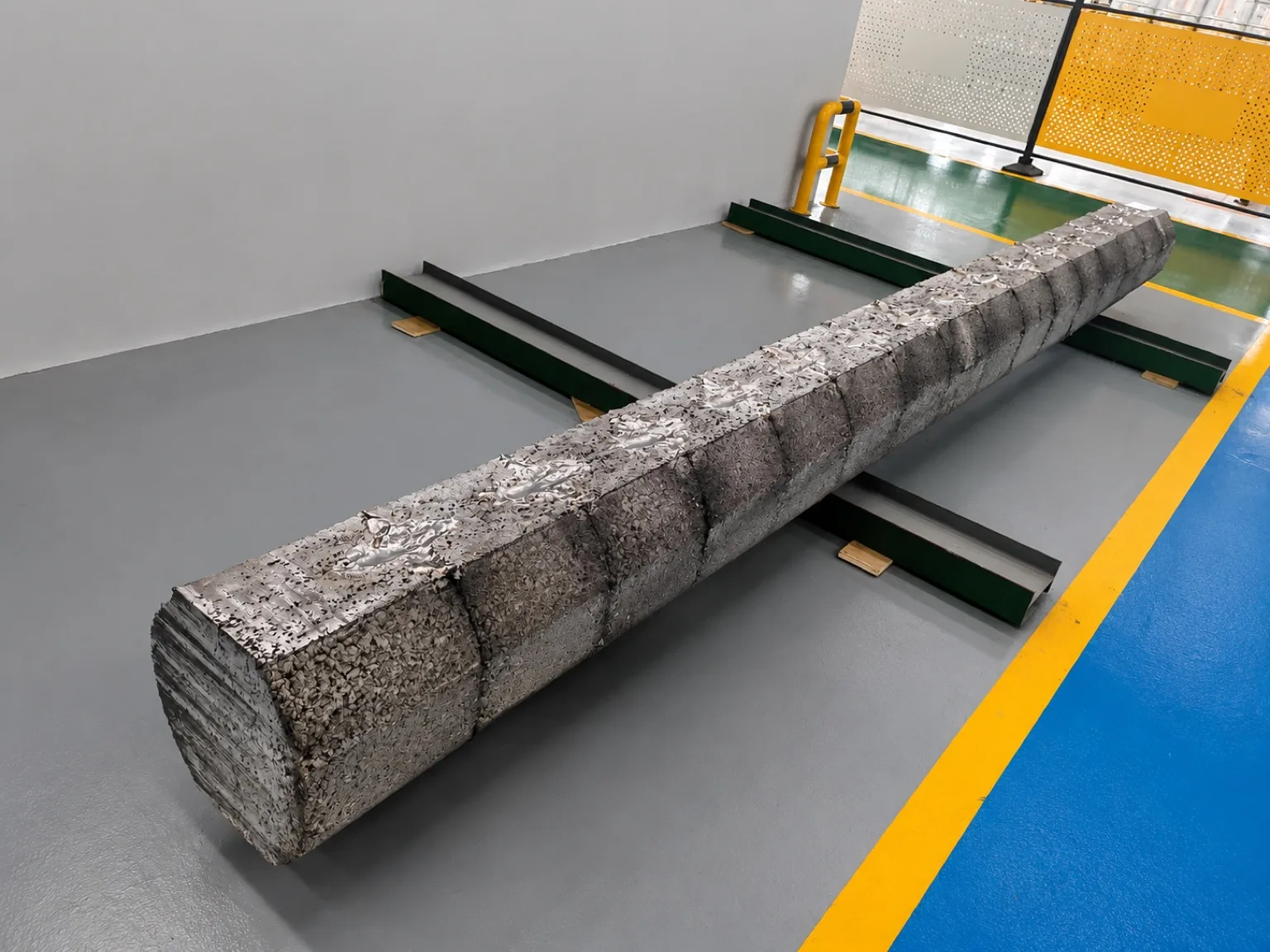
Generic downstream-form context: powder-route evidence still has to connect to consolidation, inspection and application release.
The buyer question is not whether continuous processing is promising. It is which evidence has to remain equivalent, and which changes require a new approval.
| Decision layer | What the release adds | What still needs a controlled bridge |
|---|---|---|
| Campaign execution | Four runs, 41 hours and more than 500 kg | Longer campaigns, starts and stops, interruptions, maintenance and repeatability |
| Powder condition | Oxygen ranges and averages | Full chemistry, particle distribution, morphology, density, flow, contamination and sampling |
| Process inputs | Magnesium, hydrogen and power comparisons | Feedstock equivalence, residence time, mass balance, yield, by-product handling and measurement basis |
| Downstream use | A pathway from powder to components is described | Representative builds or consolidation, heat treatment, microstructure, properties, fatigue and nondestructive-testing correlation |
| Release authority | The disclosed campaign results do not establish customer approval | Change control, qualification authority, approved-use boundary and lot-release records |
| Industrial scale | Q4 integration and engineering work are planned | Complete line, sustained uptime, audited cost, released capacity and customer demand |
This matrix keeps one strong result from carrying claims it was not designed to support. It also gives the supplier a practical route to close the gap: preserve the campaign genealogy, compare the continuous and batch routes on the same input and output basis, and tie representative powder lots to downstream evidence.
Resource ratios are directional, not a contract cost model
IperionX reports more than 45% lower magnesium use, more than 60% lower hydrogen use and more than 75% lower power use per kilogram against its batch reference process. It also reports six times the throughput volume on a like-for-like run-time basis. These are relevant operating signals because they address reagents, energy and furnace productivity.
They do not by themselves establish delivered unit cost or released annual capacity. The disclosed campaign results do not establish a complete mass balance, yield, labor basis, maintenance burden, full-line bottleneck analysis or audited cost calculation. The release also says that further campaigns will evaluate and quantify by-product handling, and that Q4 work will integrate the furnace into a full powder production line and advance industrial-line engineering.
For sourcing models, record the ratios as issuer-reported development results. Do not apply them directly to contract pricing, lead time or capacity allocation until the complete route and commercial basis are available.
What should change in a buyer’s file now
Update the process status to “four continuous GenX campaigns completed.” Do not change powder status to “qualified,” component status to “approved,” or capacity status to “released.” Keep those as separate gates.
If the contract or application makes route equivalence material, consider requesting lot-linked chemistry and particle data, the sampling plan, interrupted-run disposition, campaign mass balance and yield, start-stop records, and a change comparison against the approved route. Representative downstream evidence and the named approval authority can then define whether the bridge is sufficient.
IperionX also says GenX is not required for its existing 200 metric-tonnes-per-year (tpa) production ramp or planned Virginia expansions. That separation matters: GenX campaign progress should not be used to infer that the separate 200 tpa ramp has been completed, and progress on that ramp should not be used to fill GenX’s missing equivalence evidence.
The current evidence supports a narrow but useful conclusion. GenX has moved into disclosed multi-campaign testing with measured oxygen and operating comparisons. Buyers now have enough information to open a formal process-equivalence review, but not enough to close powder, build, customer or industrial-capacity release.
Sources
- IperionX, “IperionX Validates GenX Continuous Titanium Production,” published September 16, 2026 and accessed September 17, 2026: https://iperionx.com/2026/09/16/iperionx-validates-genx-continuous-titanium-production/
FAQ
# Do the disclosed oxygen results qualify GenX titanium powder for production use?
# Can the reported magnesium, hydrogen, power and throughput improvements be used as a commercial cost or capacity figure?
# What evidence is needed before continuous GenX can replace an approved batch route?
Need this material? Get a factory-direct quote.