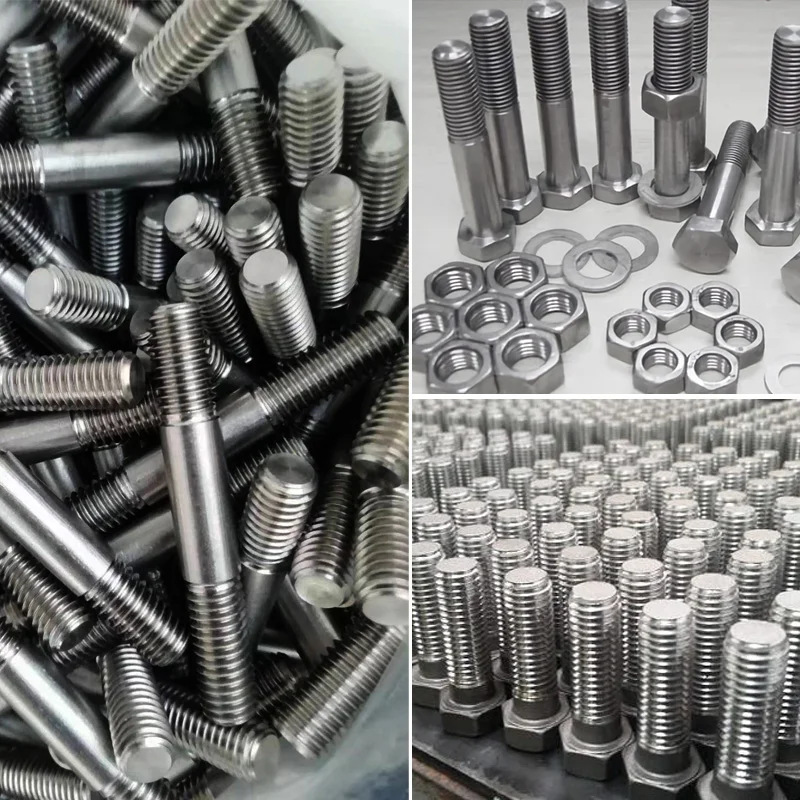
An Introduction to High-Performance Titanium Fasteners
Titanium nuts, bolts, screws and washers offer roughly 40% lower weight than steel (R. R. Boyer, JOM, 2010) and strong resistance to chloride and seawater corrosion. They are used in chemical processing, marine and offshore equipment, desalination and industrial machinery where stainless steel suffers pitting or crevice attack.
Titanium Fasteners
Metric threads from M1.6 to M64 and imperial threads from #0 to 2-1/2” are supplied through our partner network as hex bolts, socket cap screws, hex and flange nuts, studs, threaded rods, washers and custom parts to drawing.
- Custom requirements: send your drawing or specification for a quote.
Common Grades for Titanium Fasteners
The grade of titanium is crucial as it determines the fastener’s strength and application suitability.
| Grade | Common Name(s) | Key Characteristics & Features | Typical Fastener Applications |
|---|---|---|---|
| Grade 5 | Ti-6Al-4V | High Strength. The most common grade for fasteners. Offers an exceptional strength-to-weight ratio, far exceeding steel in this regard. | High-load industrial and structural bolting. |
| Grade 2 | CP Ti Grade 2 | Superior Corrosion Resistance. Moderate strength with excellent ductility and weldability. Used where corrosion resistance is the primary concern. | Marine equipment, chemical plant fixtures, architectural attachments. |
| Grade 7 | Ti-0.2Pd | Premium Corrosion Resistance. Similar to Grade 2 but with enhanced resistance to acids and crevice corrosion due to palladium. | Fasteners for specialized chemical reactors, desalination equipment, and highly aggressive environments. |
Example Applications of Titanium Fasteners
Titanium fasteners are chosen when standard materials are not sufficient to meet the service environment demands.
Marine
- Above and Below Waterline: Resistant to saltwater corrosion, titanium bolts are used for securing deck hardware, masts, propellers, and underwater equipment on yachts and ships.