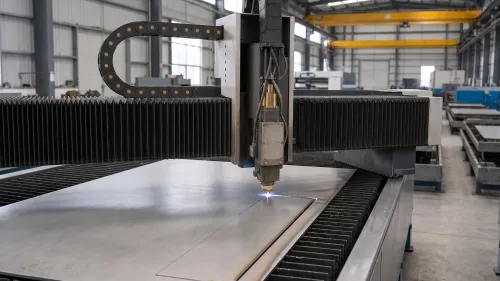
Titanium Laser Cutting
Cutting titanium on a laser is not hard. Cutting it with the wrong assist gas is, and the damage does not show on the cut edge — it shows later, when the part cracks during forming or fails a TIG weld.
Titanium reacts with oxygen and nitrogen at cutting temperatures. An oxygen-assisted cut — the standard, cheaper setting used for mild steel — leaves a hard, brittle oxide and nitride layer along the kerf. That layer is alpha case. It is invisible on the surface, it does not polish out, and it has to be machined or pickled away before the blank can be formed or welded.
High-purity argon assist gas is what prevents it. Through our certified partner facilities, titanium laser cutting is performed under high-purity argon shielding so the edge stays bright, silver, and ductile — ready to go straight to the next operation.
This is the first question worth asking any supplier who quotes you titanium laser cutting: what gas do you shield the cut with? If the answer is oxygen or nitrogen, the price difference has been taken out of your edge quality.
Grades and Formats
Laser cutting suits flat product — sheet and plate and thin titanium foil — as well as thin-wall tubing on multi-axis rotary laser systems.
| Material | Common formats | Typical uses |
|---|---|---|
Grade 1 (UNS R50250 / Werkstoff 3.7025 / ВТ1-00) & Grade 2 (UNS R50400 / 3.7035 / ВТ1-0) | Foil, sheet, and tube | Motorsport exhaust pie cuts, chemical gaskets, heat-exchanger and anode blanks |
Grade 5 (Ti-6Al-4V) (UNS R56400 / Werkstoff 3.7165 / ВТ6) | Sheet and light plate | Motorsport brackets, exhaust flanges, and custom EDC hardware blanks |
| Grade 7 / Grade 12 | Sheet | Corrosion-critical chemical and marine components |
If your drawing calls for a different grade, thickness or format, send it with the RFQ — cuttability, route, tolerances, and lead time are confirmed per drawing and order specification.
Rotary Laser Tube Cutting & Ultrasonically Cleaned Pie Cuts
Beyond flat sheet profiling, our certified partner facilities run multi-axis rotary fiber lasers engineered specifically for Motorsport & Exhaust Fabrication:
- Thin-Wall Exhaust Tubing Coverage: We process commercially pure Grade 1 (
UNS R50250 / Werkstoff 3.7025 / ВТ1-00) and Grade 2 (UNS R50400 / Werkstoff 3.7035 / ВТ1-0) seamless and welded tubing across outside diameters fromOD 38.1–101.6 mm (1.50"–4.00")and wall thicknesses from0.8–1.2 mm (0.031"–0.047"). - Precision Miters, Pie Cuts & Coped Joints: Multi-axis rotary heads produce tight-radius laser-cut pie cuts (such as
4.5° / 9° / 15°miter segments) and saddle-coped or slotted branch joints (fishmouth collector transitions) with zero mechanical crushing or ovality distortion. - Ultrasonically Cleaned & Weld-Ready Out of the Bag: Every rotary laser cut is shielded with high-purity argon to prevent oxide dross on the inner and outer walls. After mechanical deburring, all pie cuts and tube segments are ultrasonically cleaned to remove cutting oils and particulates, then delivered in individually sealed packaging. Fabricators can open the bag, fixture the segments on the purge rig, and start back-purged TIG welding immediately without spending hours deburring and wiping hundreds of rings with acetone. See our dedicated product page for Titanium Exhaust Tubing & Laser-Cut Pie Cuts.
What Gets Confirmed at Quotation
- Kerf and heat-affected zone. Fiber-laser cutting of titanium typically runs a kerf in the tenths of a millimetre (
0.1–0.3 mm / 0.004"–0.012") with a narrow HAZ. Dimensional tolerances and edge allowances for your part depend on thickness and geometry and are confirmed per drawing and order specification. - Edge condition. As-cut, deburred, or ultrasonically cleaned and sealed — matched to whether the blanks go on to forming, TIG welding and fabrication, knife & EDC finishing, or CNC machining.
- Thickness fit. Foil (
0.05–0.5 mm / 0.002"–0.020") and light-to-medium sheet (0.8–6.0 mm / 0.031"–0.236") are the laser’s natural range. Above that, a water jet is usually the better tool, and we will say so rather than quote a route that damages the part. - Traceability. Blanks are cut from certified stock and ship with a Material Test Certificate (MTC) with heat-lot traceability and Certificate of Conformance (CofC) so incoming inspection at CNC machine shops can trace every part back to its heat and lot.
Choosing the Cutting Route
| Method | Best for | Edge character |
|---|---|---|
| Laser cutting | Foil, sheet, rotary thin-wall tube, complex flat profiles, repeat batches | Narrow kerf, small HAZ, argon-shielded bright edge |
| Water-jet cutting | Thick plate, HAZ-sensitive parts, knife scale blanks | Cold cut, zero HAZ, slight taper on thick sections |
| Band-saw cutting | Bar, billet, heavy-wall tube cut to length | Production cut-off, machining allowance retained |
See cut to length for the full comparison.
Common Questions
Does laser cutting embrittle titanium edges? Not when the cut is shielded correctly. With high-purity argon the edge stays ductile and weldable. Unshielded or oxygen-assisted cutting is what creates alpha case.
What thicknesses can be laser cut?
Foil from 0.05 mm (0.002") up through light and medium sheet (0.8–6.0 mm / 0.031"–0.236") is the natural laser range. Send the drawing — if laser is not the right tool for your thickness, we quote water jet or saw instead.
What files do you accept? DXF, DWG, STEP or PDF. For repeat production the cutting programs are kept on file so follow-up batches match the first article.
Is there a minimum order? No for stock gauges — see small quantities, where available. Prototype quantities and single blanks are routine.
Ordering
Send the drawing or DXF, the grade and thickness, the quantity, the edge condition you need, and what happens to the blank next. That last item decides the edge specification and sometimes the cutting route itself.