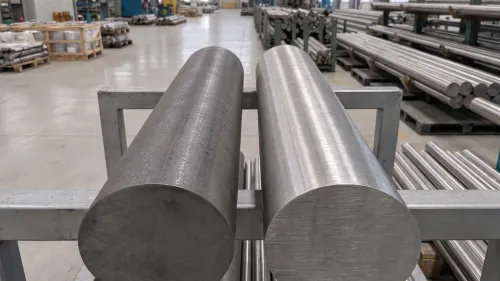
Hot-Rolled / Peeled Round Bar vs. Centerless-Ground Titanium Bar
When sourcing Titanium Rods for CNC Machine Shops, buyers must choose between two fundamentally different delivery conditions: hot-rolled / peeled round bar and centerless-ground bar. While both start from the same ingot melt and carry identical bulk mechanical properties, their surface conditioning, roundness, straightness, and diameter tolerance classes determine how they behave inside a CNC lathe.
Ordering centerless-ground bar when you are sawing short billets for a 3-jaw chuck wastes budget on unnecessary grinding passes. Conversely, feeding standard peeled bar into a Swiss-type CNC lathe guide bushing leads to immediate bar jamming, galling, and ruined collets.
1. What Is Hot-Rolled / Peeled Titanium Round Bar?
Standard Titanium Round Bar (often supplied in the hot-rolled, forged, and rough-peeled or rough-turned condition) is produced to remove the brittle oxygen-enriched surface layer (alpha case) left by hot working, leaving a clean metallic surface with visible rotary cutter marks and bilateral mill tolerances.
- Typical Diameter Range:
Ø 15.0–300 mm (0.59"–11.81") - Best Machine Setup: 3-jaw hydraulic chucks, 4-jaw independent chucks, or saw-cut billet fixturing where every external surface is rough- and finish-turned.
- Common End Uses: Motorsport & Exhaust Fabrication V-band flange blanks, Marine & Subsea Engineering ROV end caps, pump shafts, and heavy machined valve bodies.
2. What Is Centerless-Ground Titanium Bar?
Centerless-Ground Titanium Bar undergoes rotary straightening followed by multi-pass cold wet grinding between a high-speed grinding wheel, a regulating wheel, and a work-rest blade. Instead of bilateral mill tolerances (±), centerless-ground bars are finished to ISO 286-2 unilateral negative tolerance classes (h6, h7, h8, h9), where the upper deviation is strictly 0 and all variation sits on the minus side.
- Typical Ground Diameter Range:
Ø 3.0–50.8 mm (0.118"–2.000"), including standard Imperial fractional sizes (1/8",3/16",1/4",5/16",3/8",1/2",5/8",3/4",1.000") in1,000–3,000 mm (39.4"–118.1")bar-feeder lengths. - Best Machine Setup: Swiss-type sliding-headstock CNC lathes (guide-bushing systems), high-speed collet chucks, and automatic hydrodynamic bar feeders.
- Common End Uses: Knife Making & Custom EDC pivot barrels, thumb studs, standoffs, custom UNC/UNF fasteners, and high-precision instrument shafts.
Engineering Comparison: Peeled Round Bar vs. Centerless-Ground Bar
| Engineering Parameter | Hot-Rolled / Peeled Round Bar | Centerless-Ground Bar (ISO 286-2) |
|---|---|---|
| Typical Diameter Range | Ø 15.0–300 mm (0.59"–11.81") | Ø 3.0–50.8 mm (0.118"–2.000") |
| Tolerance Convention | Standard bilateral mill tolerances ( includes + oversize allowance) | Unilateral negative h6 / h7 / h8 / h9 (+0 upper deviation) |
| Surface Condition | Rough-turned / peeled metallic finish with visible feed spirals | Bright, low-roughness precision ground finish |
| Out-of-Roundness & Lobing | Standard mill ovality; requires initial roughing pass to true up | Tightly controlled circularity for high-RPM collet concentricity |
| Swiss Guide-Bushing Compatibility | Unsuitable — positive diameter drift causes binding and galling | Engineered for guide bushings — chamfered ends & zero oversize |
| Primary Machining Allowance | Requires 1.5–3.0 mm (0.060"–0.120") radial stock allowance | Can be used directly as finished OD or skimmed with minimal pass |
Why Swiss Lathes vs. 3-Jaw Chucks Dictate Your Choice
The Swiss Lathe Guide-Bushing Problem
In a Swiss-type CNC lathe, the bar slides continuously through a carbide guide bushing positioned right behind the turning tool. Because titanium alloys readily gall and cold-weld against carbide under friction, any positive diameter deviation (+ tolerance) on a standard bar will cause the bar to seize inside the bushing. Conversely, if the bar is too far undersize, radial play inside the bushing allows the low-modulus titanium bar to deflect away from the tool, causing chatter and taper.
Specifying ISO 286-2 h6, h7, h8, or h9 centerless-ground bar guarantees a +0 upper limit. You can verify the exact micrometer/thousandth tolerance band for any metric or Imperial diameter in real time using our interactive Tolerance Calculator, and lock that class in your order confirmation.
The 3-Jaw Chuck & Saw-Cut Billet Scenario
If your shop saws bars into 50–150 mm (2.0"–6.0") blanks and clamps them in a conventional 3-jaw chuck, the chuck jaws easily accommodate standard mill diameter tolerances. In this workflow, ordering peeled round bar and adding a 1.5–3.0 mm (0.060"–0.120") diameter allowance is the most cost-effective engineering choice. Use our Weight & Allowance Calculator (in Machining Allowance Mode) to compare the net weight and cost impact of rough bar allowance vs. ground bar stock.
Available Grades Across Our Partner Network
Through our certified partner facilities, we supply both peeled round bars and bar-feeder ready centerless-ground bars with a Material Test Certificate (MTC) with heat-lot traceability and Certificate of Conformance (CofC):
- Grade 5 (
Ti-6Al-4V|UNS R56400|Werkstoff 3.7165|ВТ6): High-strength alpha-beta workhorse for fasteners, pivot hardware, motorsport studs, and structural shafts. - Grade 23 (
Ti-6Al-4V ELI|UNS R56407|Werkstoff 3.7165-ELI|ВТ6С): Extra-Low Interstitial grade for precision instrumentation and subsea pressure stems. - Grade 2 (
Commercially Pure Titanium|UNS R50400|Werkstoff 3.7035|ВТ1-0): Optimal seawater and chemical corrosion resistance for valve stems, fluid couplings, and marine pins.
Ready to Specify Your Bar Stock?
Explore full specifications for our bar-feeder ready stock on the Centerless-Ground Titanium Bar service page, check your exact ISO fit limits in the Tolerance Calculator, or request a direct quote below.