From November 17 to 20, 2026, at Formnext 2026 in Frankfurt, Germany, Berlin-based metal additive equipment builder GEFERTEC spotlighted its purpose-built arcTitan Wire Arc Additive Manufacturing (WAAM) platform at Hall 12.1, Stand B101. Large-format titanium deposition is maturing. Displayed alongside the modular arc10X and heavy-duty arc80X systems—and backed by full-scale demonstrator hardware including a titanium aircraft emergency exit frame—the platform targets aerospace and industrial OEMs seeking alternatives to long-lead, high-scrap structural billeted hogouts.
According to technical specifications presented at the Frankfurt exhibition, arcTitan replaces open-air local trailing shields with a fully enclosed, sealed inert-gas build chamber that maintains residual oxygen between 10 and 15 ppm throughout deposition, pairing a 2,000 × 700 × 1,000 mm build envelope with plasma-arc deposition rates up to 3 kg/h. Hardware atmosphere barriers are falling.
For aerospace structures engineers and specialty-metal procurement leads evaluating near-net-shape titanium preforms, sealed-chamber plasma WAAM solves machine-side shielding; yet passing ultrasonic and radiographic lot release depends equally on the metallurgical cleanliness of the spooled wire fed continuously into the torch. As an integrated titanium supply-chain platform working with certified partner facilities worldwide, we examine where enclosed WAAM complements heavy forgings and define actionable procurement rules for additive-grade titanium wire. Feedstock purity governs part release.
What a 10–15 ppm Inert Chamber Solves—and Why Dirty Wire Still Causes Scrap
When depositing reactive titanium in open-shop environments, localized gas turbulence around sharp structural corners pulls ambient air into the cooling weld trail, creating brittle oxygen-enriched interlayer zones. Shielding gaps ruin large builds. By flooding a sealed 2,000 × 700 × 1,000 mm chamber with protective gas held strictly between 10 and 15 ppm oxygen, GEFERTEC’s arcTitan architecture eliminates path-dependent trailing-shield blind spots across complex multi-axis geometries.
However, metallurgical auditors must enforce an equally critical boundary: a 10 to 15 ppm chamber blocks external air leaks, but it cannot purify carbon, hydrogen, or oxide scale riding into the melt pool on contaminated wire feedstock. Internal wire contamination bypasses chamber gas. Printing a 60 kg near-net Grade 5 (Ti-6Al-4V) structural frame at 3 kg/h consumes roughly 20 hours of uninterrupted arc time and thousands of meters of spooled wire; substituting low-cost manual repair wire introduces two costly production failures:
- Interlayer Hydrogen Porosity from Drawing-Lubricant Residue: Conventional wire workshops draw rod through carbonaceous soap or mineral-oil dies; incomplete degreasing or unbuffered hydrofluoric acid pickling traps trace hydrocarbons and absorbed hydrogen inside micro-pits along the wire skin. Plasma heat cracks residual oil instantly. Even inside a 10 ppm argon chamber, dissociated atomic hydrogen dissolves straight into liquid titanium, leaving strings of interlayer micro-pores that fail radiographic inspection.
- Unattended Robotic Torch Jams from Uncontrolled Cast and Helix: Manual TIG welders instinctively compensate for curved filler rods, whereas a sealed inert-gas chamber cannot be opened mid-build to clear a bird-nested wire feeder without losing hours of purge gas. Wire feed jams scrap entire preforms. Multi-pass cold drawing work-hardens titanium rapidly (fine diameters require 3 to 8 intermediate annealing cycles to restore ductility); without precision tension straightening and level winding, spooled wire springs into tight helices that wear contact tips and deflect plasma arc alignment.
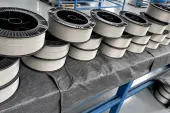
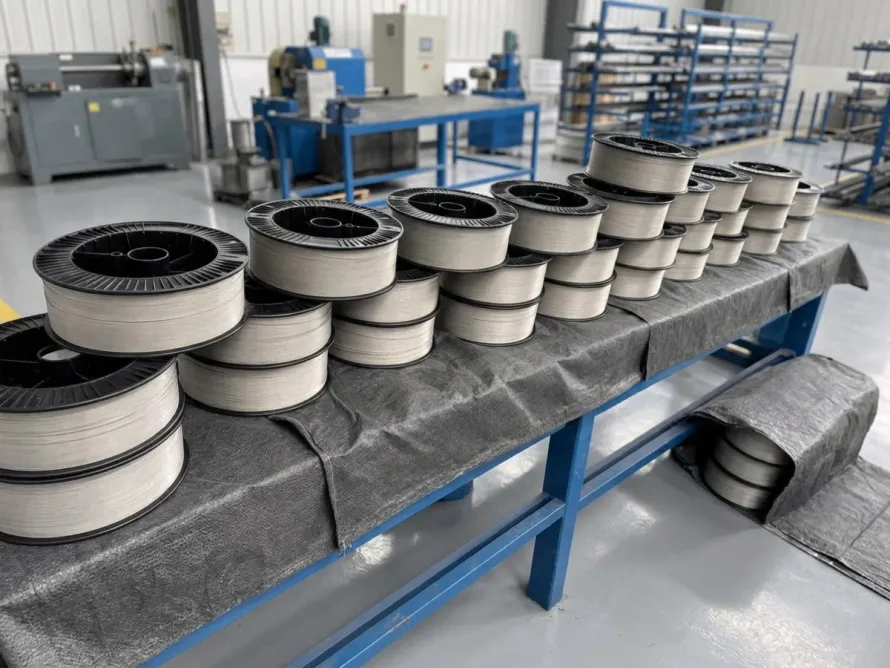
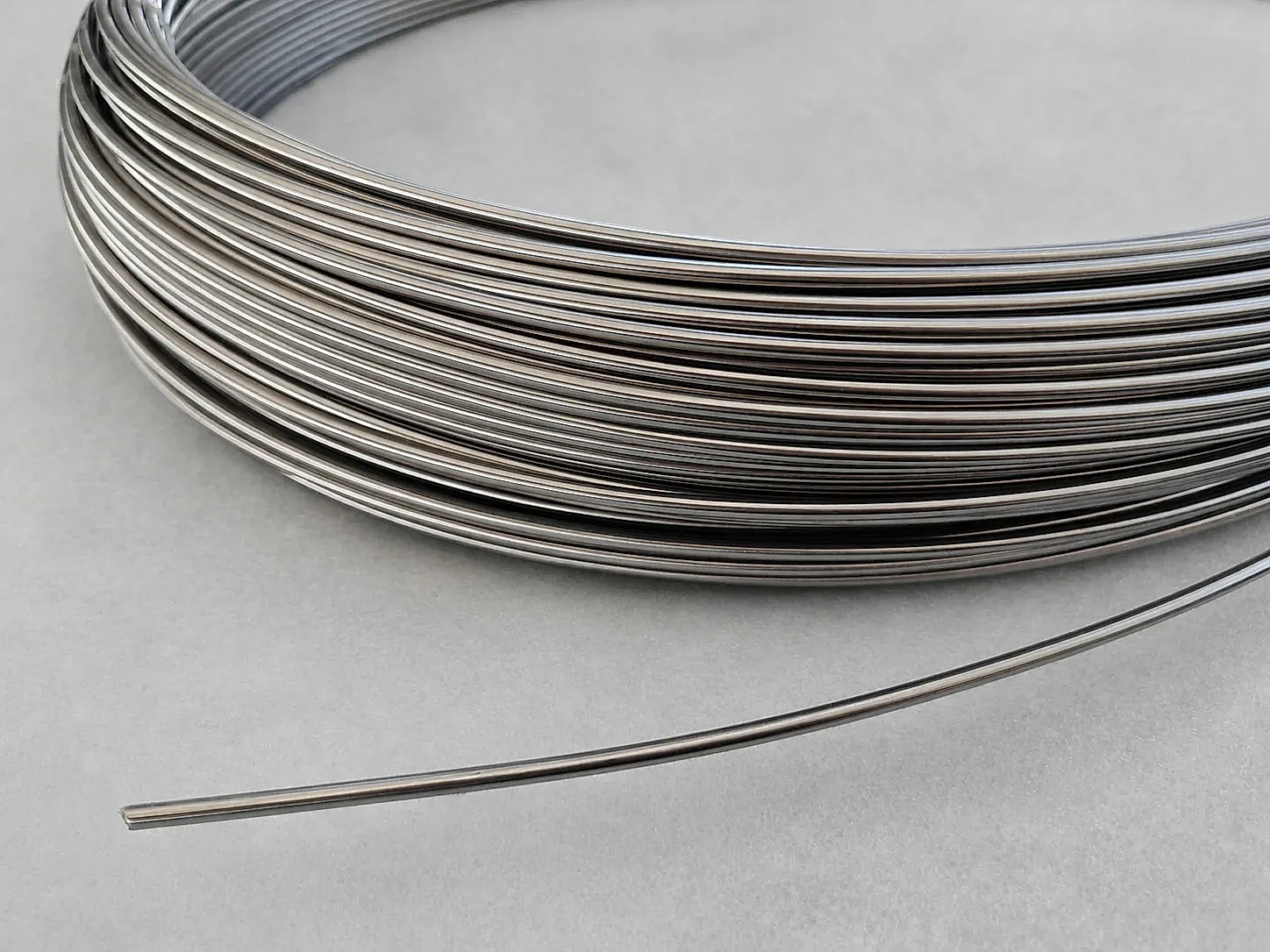 Figure 1: Close-up of enclosed oil-free drawn, eddy-current inspected, and vacuum bright-annealed titanium printing wire. Mirror-clean surface finish and controlled spool geometry prevent hydrogen porosity and robotic feed interruptions during multi-hour builds.
Enclosed Plasma WAAM vs. Powder-Bed LPBF vs. ASTM B381 Forgings: 2026–2027 Sourcing Matrix
With large-envelope wire-arc cells and multi-tonne powder atomizers advancing simultaneously at Formnext 2026, sourcing teams should not treat WAAM as a blanket replacement for closed-die or ring-rolled forgings, but rather match each manufacturing route to envelope size, buy-to-fly math, and fatigue qualification baselines. Smart routing optimizes total cost.
| Evaluation Dimension | Enclosed Plasma Wire-Arc AM (e.g., arcTitan WAAM) | Laser Powder Bed Fusion (LPBF Spherical Powder) | Conventional Open-Die & Ring Forging (ASTM B381) | 2026–2027 Buyer Sourcing Rule |
|---|---|---|---|---|
| Part Envelope Scale | Medium-to-large frames (up to 2,000 × 700 × 1,000 mm) | Small-to-medium intricate parts (typically ≤ 400 – 600 mm) | Broad range from compact flanges to multi-tonne rings | Use WAAM for hollowed frames over 1 meter; LPBF for internal channels |
| Deposition Rate & Buy-to-Fly | Up to 3 kg/h; reduces near-net buy-to-fly to 2:1 – 4:1 | Tens to hundreds of grams/hour; ultra-fine net resolution | Hogging solid blocks or forgings often runs 8:1 – 15:1 buy-to-fly | Replace high-hogout plate pockets with WAAM preforms to cut chip waste |
| Primary Feedstock Form | 0.8 mm – 3.2 mm oil-free bright spooled wire (AWS A5.16) | 15 – 53 μm gas- or plasma-atomized spherical powder | Multi-tonne 2x/3x VAR ingots converted into forged billets | Spooled wire costs far less per kg than AM powder with zero dust hazard |
| Microstructure & Post-Step | Epitaxial columnar beta grains; requires HIP or anneal + finish CNC | Fine acicular martensite; requires vacuum stress relief or HIP | Multi-axis thermo-mechanical grain refinement and continuous flow | Keep rotating rotor discs and fatigue-critical hubs on qualified forgings |
| Primary Release Bottleneck | Wire surface C/H porosity, feed stability, interlayer UT/RT | Powder lot oxygen pickup, inclusions, trapped-powder removal | Heavy press queue times, grain-flow symmetry, ultrasonic noise | Enforce full heat-lot traceability and verified O/N/H assays across all routes |
In practice, hollowed aircraft door frames, spacecraft thruster brackets, and custom subsea mounts achieve substantial material savings by pairing precision additive-grade titanium wires with enclosed WAAM cells; meanwhile, high-cycle fatigue rotor hubs and pressure-vessel flanges continue to rely on established aerospace and industrial titanium forgings where wrought alpha-beta grain flow is already locked into airworthiness baselines.
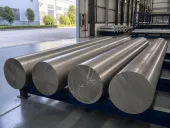
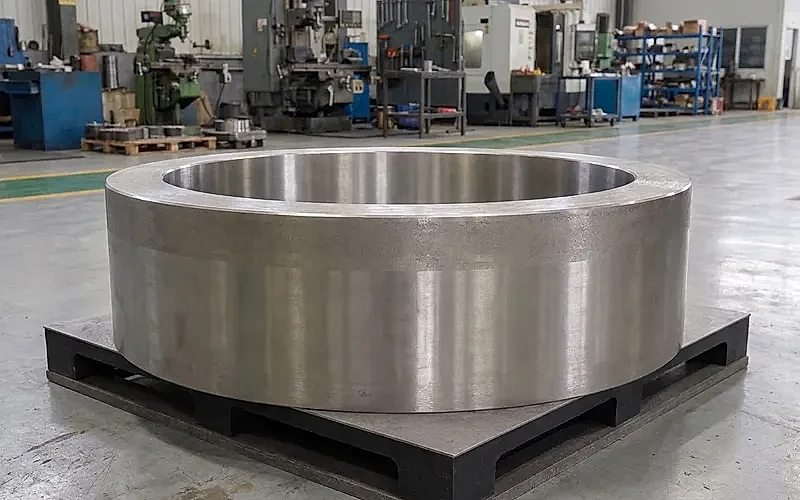 Figure 2: Large-diameter seamless rolled titanium ring forging at a certified partner facility. Wrought circumferential grain flow in heavy rings complements near-net WAAM structural frames across 2026–2027 aerospace and energy programs.
Four RFQ Acceptance Controls for Additive-Grade Titanium Wire (WAAM & Laser DED)
To support multi-hour unattended deposition on enclosed plasma WAAM and laser Directed Energy Deposition (DED) platforms, certified partner facilities operate dedicated additive wire lines segregated from general industrial straight-cut rod stock. Dedicated processing protects melt purity. Buyers issuing RFQs under AWS A5.16 (ERTi-2, ERTi-5, ERTi-23) or ASTM B863 should lock in four concrete controls:
- Enclosed Oil-Free Drawing and Vacuum Bright Annealing: Partner additive wire lines utilize enclosed oil-free drawing paired with vacuum bright annealing and tension straightening across diameters from 0.8 mm to 3.2 mm. Oil-free drawing stops porosity at the source. Eliminating carbonaceous drawing lubricants keeps residual surface carbon and hydrogen minimal, ensuring stable plasma arc ignition without spatter or soot deposits.
- Source 2.5 mm and 3.2 mm Heavy WAAM Diameters from Standard Stock: High-throughput 3 kg/h plasma torches frequently favor thicker wire diameters to lower linear wire-feed speeds and reduce surface-area-to-volume oxide carry-in. Heavy wire sizes sit in standard stock. While first-time buyers often assume 2.5 mm and 3.2 mm titanium wires require custom tooling and multi-week surcharges, certified partner mills maintain both 2.5 mm and 3.2 mm as standard rolling/drawing inventory ready for rapid level-wound spooling.
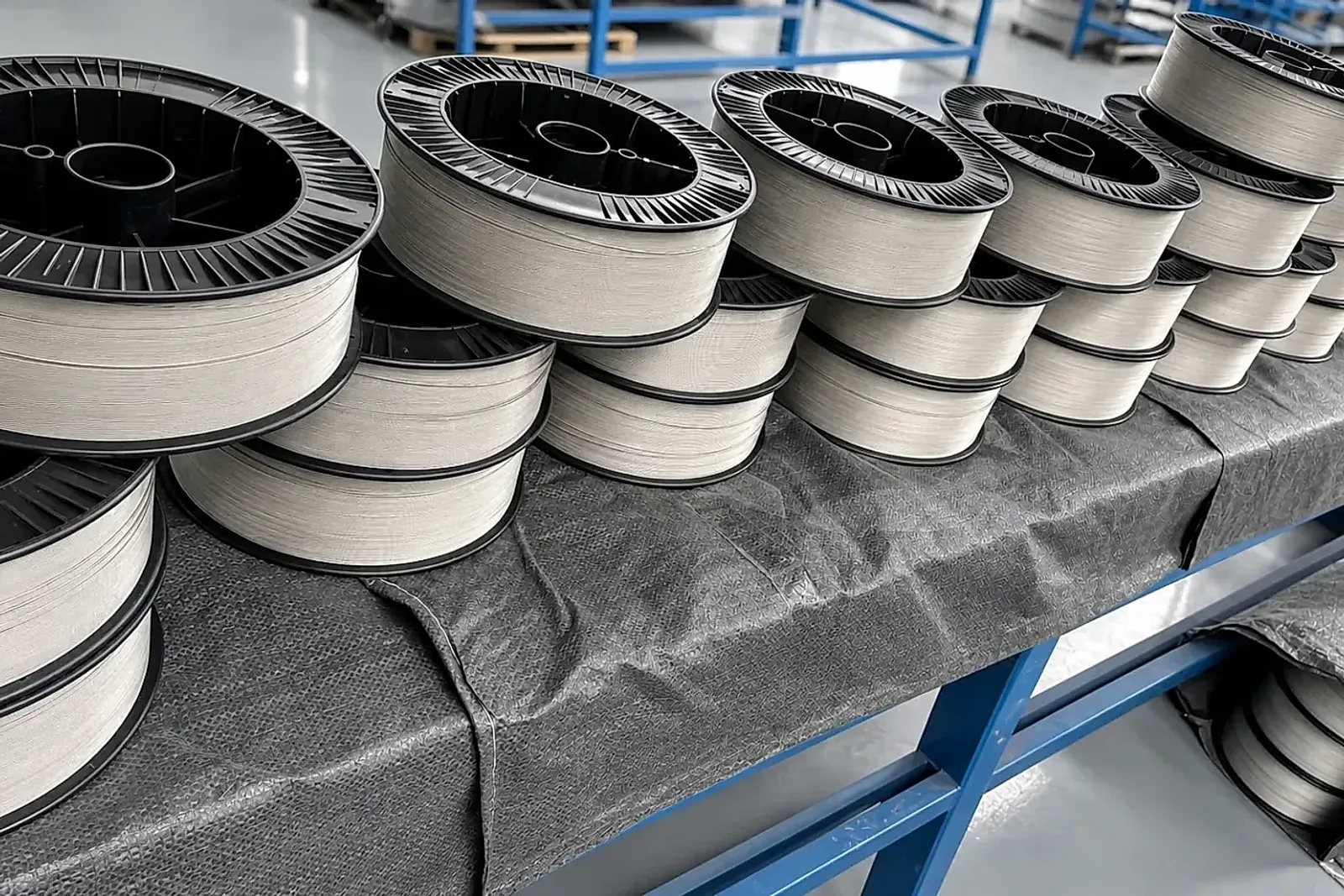
- 100% In-Line Eddy-Current Testing and Precision BS300 Level Winding: Every additive wire lot passes 100% in-line eddy-current flaw detection prior to spooling to screen out seams, laps, and subsurface inclusions, followed by precision layer-by-layer winding onto standard BS300 spools with controlled cast and helix (≤ 25 mm). Controlled helix prevents Liner drag.
- Verify MTC Interstitial Gas Assays and Ingot Traceability: Require a Material Test Certificate (MTC) with unbroken heat/lot number traceability back to the primary VAR ingot, confirming commercial and structural interstitials stay within O ≤ 0.20%, N ≤ 0.05%, and H ≤ 0.015%—and tightening oxygen to O ≤ 0.13% on ERTi-23 (Grade 23 Ti-6Al-4V ELI) builds—with optional independent third-party inert-gas fusion O/N/H re-testing prior to dispatch under FOB China main port terms. Verified gas chemistry secures build qualification.
Whether your manufacturing team is qualifying low-hydrogen spooled titanium wire for enclosed plasma WAAM systems or comparing near-net deposition preforms against forged billets for 2026–2027 aerospace hardware, submit your wire diameter, alloy grade, and spool callouts through our online RFQ and additive feedstock specification review portal for current stock availability and sample MTC documentation. Clean feedstock powers reliable builds.