In procurement for aero-engine casing flanges, petrochemical reactor channel flanges, desalination evaporator support rings, and subsea pressure-hull stiffeners, mechanical engineers and sourcing managers face a critical manufacturing choice: should they specify ASTM B381 seamless radial-axial rolled rings (Seamless Rolled Rings), or purchase solid titanium disc forgings and trepan the inner diameter (Trepanning a Solid Disc Forging)? The choice drives project economics.
Raw material costs for titanium forgings—especially Grade 5 Ti-6Al-4V forgings—are significantly higher than those of carbon steel or stainless alloys. The forging blank method not only sets raw buy-weight and cutting tool consumption, but also governs grain flow continuity and ultrasonic testing (UT) compliance under cyclic pressure. Engineering decisions carry heavy consequences.
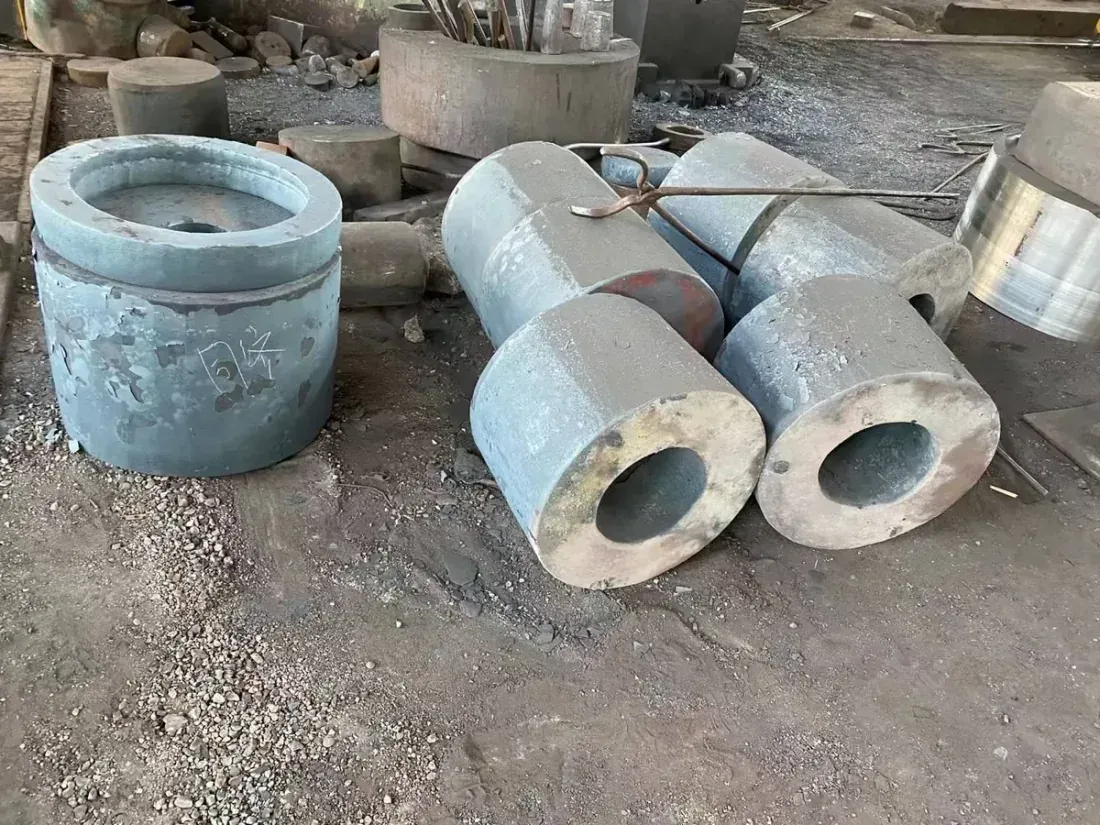
1. Metallurgical Grain Flow and Pressure Integrity: Rolled Flow vs Trepanned Interruption
ASTM B381 (Standard Specification for Titanium and Titanium Alloy Forgings) establishes strict requirements for mechanical uniformity across rings, discs, and open-die forgings. Performance standards are stringent. The two manufacturing routes exhibit fundamental differences in microstructure:
- CNC Radial-Axial Seamless Ring Rolling: Following precision temperature control in rotary hearth furnaces, pierced blanks are positioned between mandrel and main roll. Simultaneous radial and axial hydraulic forces drive continuous rotary expansion. Grain flow lines remain intact. Primary $\alpha$ phases and alloy grains align tangentially along the circumference. Because fiber lines remain unbroken and closed, resistance to fatigue crack growth under hoop stress increases by 20% to 30% (20%–30%) compared with severed grain paths.
- Solid Disc Forging Trepanning: Solid discs are produced on open-die forging presses via upset-and-draw sequences, resulting in pancake-style grain lines radiating outward. Cutting breaks internal fiber paths. When core metal is trepanned out, metal flow lines along the critical hoop-stress orientation are severed mechanically, creating exposed transverse grain boundaries at the ID bore that facilitate micro-void nucleation under cyclic stress.
At partner forging facilities, production lines integrate a 2,500-ton high-speed hydraulic forging press, a 10-ton electro-hydraulic hammer, and rotary hearth furnaces. Equipment capabilities are formidable. Through tightly controlled beta breakdown and alpha-plus-beta upset-and-draw forging, grain size consistently achieves ASTM E112 Grade 8 to 10 (numbers 8 to 10), ensuring uniform structural refinement.
2. Procurement Cost Breakeven: Raw Material Yield vs Trepanning Waste
Titanium’s high density and raw price make “buying metal to make chips” the primary driver of cost overruns. Cost vigilance is imperative. Sourcing teams must evaluate buy-to-fly ratios rigorously:
- Material Yield Comparison: ASTM B381 seamless rolled titanium rings (covering 200 mm to 2,500 mm OD) formed on CNC radial-axial mills boost material utilization by over 35% (>35%) compared with trepanning solid discs. Raw material savings are substantial. For an 800 mm OD × 600 mm ID × 200 mm height Grade 5 ring (net finished weight roughly 198 kg), material efficiency is paramount.
- Solid Disc Trepanning Scrap: Trepanning from a solid disc requires an 820 mm OD × 220 mm thick blank weighing over 520 kg, turning more than 280 kg of core titanium into scrap. Trepanning losses are staggering. While trepanned solid cores retain some secondary scrap value, recyclers discount titanium reverts by over 50%, and heavy tooling wear further inflates total expenditure.
- Batch Size and Tooling Breakeven: Ring rolling requires pre-forming pierced donuts and machine setup time. For a single piece with non-standard dimensions, trepanning a solid stock disc may offer shorter lead time; but once order quantities reach 3 to 5 pieces (3 to 5 parts) or more, seamless rolled rings cut total procurement costs by 15% to 25% (15%–25%). Savings accumulate rapidly. Sourcing specialists can utilize engineering tools at /tools/ to calculate theoretical weights and cutting losses.
3. Structured Process Comparison: Seamless Rolled Rings vs Trepanned Solid Discs
To assist pressure vessel designers and machine shop managers in rapid technical evaluation, the table below summarizes key parameters across both manufacturing methods. Key metrics are clear:
| Comparison Metric | ASTM B381 Seamless Radial-Axial Rolled Ring | Trepanned Solid Titanium Disc Forging | Rolled & Welded Plate Ring |
|---|---|---|---|
| Primary Machinery | Radial-axial CNC ring rolling mill + 2,500-ton press | Open-die forging press / hammer + trepanning lathe | Plate shear + 3-roll plate bender + automatic TIG/PAW |
| Metal Fiber Flow | Continuous circumferential tangential loop, superior fatigue | Planar radial flow, mechanically cut along inner diameter | Oriented along rolling direction, severed by weld seam |
| Material Yield | High (>35% raw metal saved vs solid disc) | Low (massive solid core converted into chips or scrap) | Very high (cutting loss limited to weld bevels) |
| Rough Machining Stock | 5 mm to 20 mm per surface (consistent wall thickness) | 8 mm to 25 mm (compensates for forged disc taper) | 3 mm to 8 mm (governed by plate flatness tolerances) |
| Ultrasonic Testing (UT) | Dual/single crystal longitudinal scan, low background clutter | Core center prone to micro-porosity and axial acoustic clutter | Weld seam and HAZ require 100% RT + liquid penetrant |
| Lot Size & Lead Time | Optimized for 3 to 100 pieces (3 to 100 parts), 15–30 days | Feasible for 1 to 2 pieces emergency orders, 7–15 days | Standard low-pressure chemical tanks, strictly non-critical |
| Pressure & Fatigue Rating | Class I High-Pressure / Aero-Fatigue (ASME / Aerospace) | Class II Medium-to-High Pressure Rating | Class III Atmospheric / Low Pressure (no cyclic loads) |
4. Ultrasonic Testing and Machining Allowance Inspection Guidelines
After receiving titanium forged ring blanks, machine shops frequently encounter inspection friction regarding ultrasonic testing indications and surface cleanup. Quality control requires rigorous procedures.
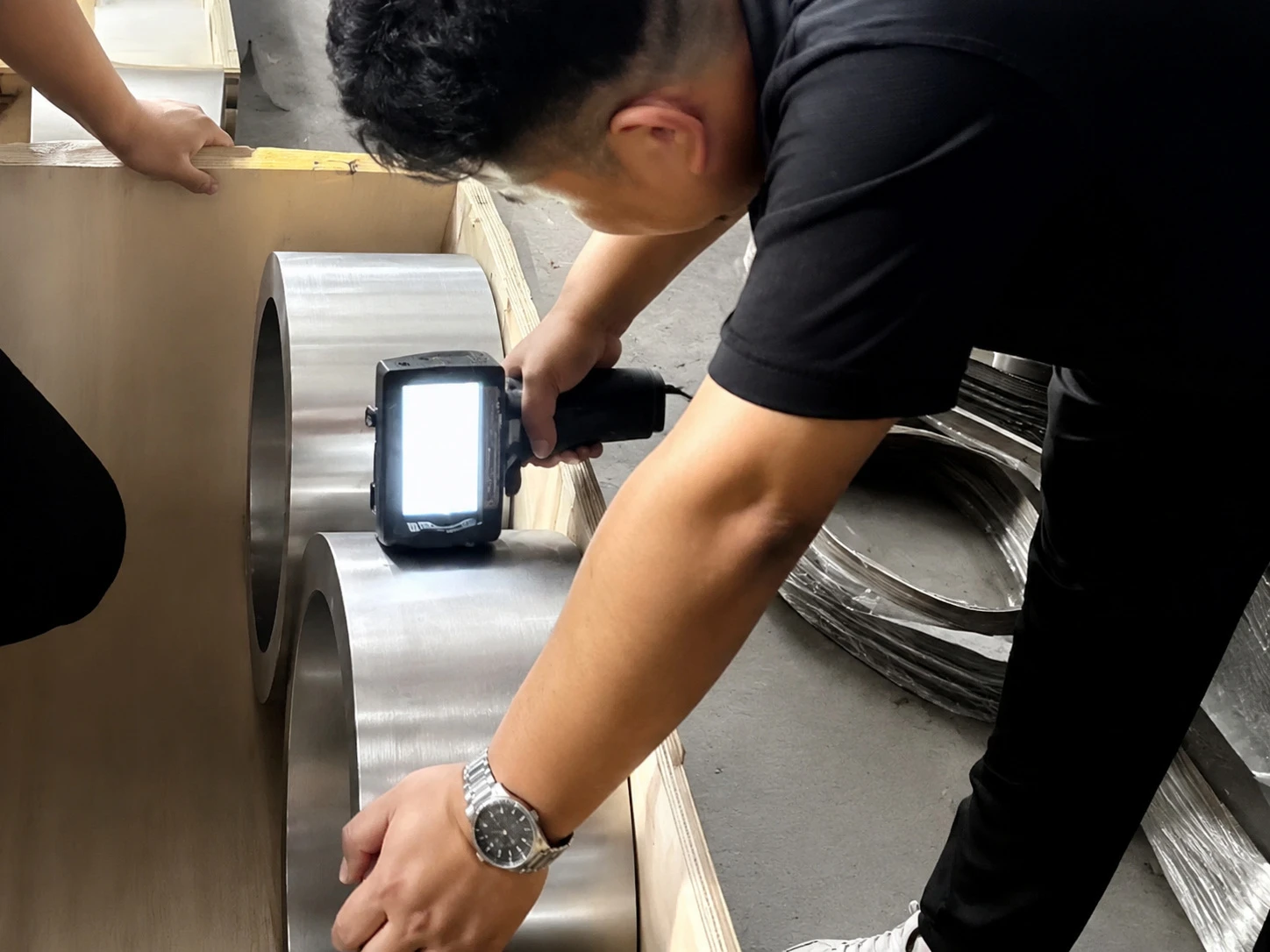
4.1 Stock Allowance Setting
Practical data from partner forging facilities indicates that rough-machined titanium forgings retain 5 mm to 25 mm of machining stock allowance per surface (5 mm to 12 mm for medium rings, 15 mm to 25 mm for large diameters). Dimensional allowances must be generous. Insufficient stock causes cleanup failure if parts warp slightly during vacuum stress-relief annealing; excessive stock inflates raw purchasing tonnage and tool wear.
4.2 Alpha-Case Oxygen-Enriched Layer Removal
When titanium is heated above 900°C, it absorbs atmospheric oxygen and nitrogen, generating a brittle $\alpha$-case layer on the surface. Brittleness must be eliminated. In fatigue-critical parts, unremoved alpha-case initiates catastrophic micro-cracks. Standard rough turning must ensure depth of cut exceeds the maximum measured alpha-case depth (turning away >= 1.5 mm to 3.0 mm of white-layer microstructure) prior to final machining.
4.3 Ultrasonic Testing (UT) Surface Preparation
Directly conducting ultrasonic testing on as-rolled black-skin surfaces violates specification standards. Black-skin testing is prohibited. Rough forged surfaces cause poor transducer acoustic coupling and severe near-surface dead zones. Compliant delivery conditions require suppliers to rough-turn outer diameters, bores, and end faces to Ra <= 3.2 μm, enabling certified NDT inspectors to perform 100% longitudinal scanning per AMS 2631 or ASTM B381, accompanied by a verified material test certificate (MTC) with complete heat traceability.
5. Engineering RFQ Review and Pre-Order Support
Prior to issuing formal purchase orders for titanium flanges, casing rings, or reactor components, procurement teams should conduct systematic specification reviews: confirm finished tolerances, design pressure, NDT sensitivity classes, and mechanical test coupon protocols. Early audits avert delays.
As an integrated titanium supply-chain platform working with certified partner facilities, our engineering group provides a Complimentary Pre-RFQ Drawing & Specification Audit. Technical backing is complete. We assist buyers in optimizing wall allowances, eliminating NDT blind spots, and calculating exact cost breakeven thresholds between seamless rolled rings and trepanned disc forgings.
Feel free to visit /get-quote/ to submit engineering drawings and material inquiries for prompt technical review, or explore our product listings below to inspect forging capabilities.
Related Products & Services
- Titanium Forgings & Seamless Rolled Rings
- Grade 5 (Ti-6Al-4V) Alloy Specifications
- Titanium Weight Calculator & Engineering Tools
- Certified Partner Forging Facilities & Testing
- Complimentary Pre-RFQ Drawing & Specification Review
Sources & Reference Standards
- ASTM B381 / B381M - Standard Specification for Titanium and Titanium Alloy Forgings (ASTM International).
- AMS 4928 / AMS 2631 - Titanium Alloy Bars, Wire, Forgings, and Ultrasonic Inspection Standards (SAE International).
- ASME Boiler and Pressure Vessel Code (BPVC), Section VIII, Division 2 - Alternative Rules for Pressure Vessel Construction and Titanium Ring Flange Design.
- Production shop floor yield statistics and ring-rolling procedures from certified partner facilities (2026).