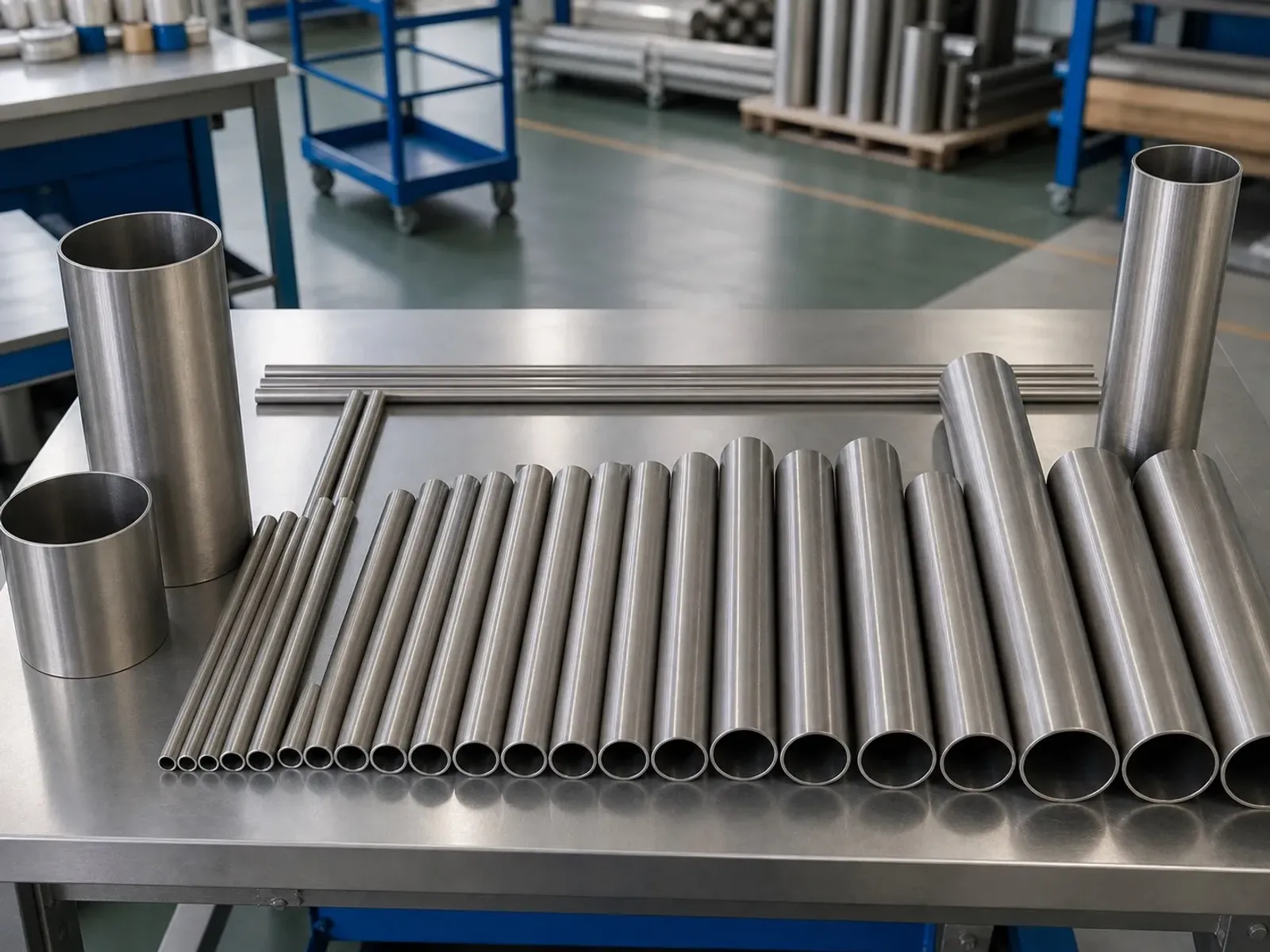
In motorsport engineering, motorcycle road racing, and track-day tuning, mass reduction directly unlocks faster lap times, shorter braking distances, and optimized chassis weight balance. Weight reduction is substantial. Where an OEM stainless steel cat-back exhaust system weighs 18 to 25 kg, an equivalent full-titanium system drops to just 8 to 12 kg, cutting overall mass by 45% to 55% (45%–55%).
However, aftermarket fabricators and custom exhaust builders frequently encounter costly manufacturing pitfalls. Bending thin-wall titanium is unforgiving. Off-the-shelf industrial tubing often wrinkles along the inner radius on CNC rotary draw benders, splits across longitudinal weld seams, or develops heat-affected zone (HAZ) stress cracks after track vibrations.
Drawing upon operational quality data from certified partner facilities, this technical guide reviews standardized metric and imperial tubing diameters, wall thickness allowances, alloy grade selection, and the critical quality gates required for tight-radius mandrel bending. Dimensional tolerances must be enforced.
1. Exhaust Tubing Diameter and Wall Thickness Matrix
According to production dispatch logs from certified partner facilities over the past 12 months, exhaust tubing inquiries concentrate across six standardized metric and imperial outside diameters (OD). Outer dimensions are highly standardized.
[Motorcycle Downpipes / Primary Exhaust Header Runners]
├── 38 mm OD (1.5")   ──> Typical Wall: 0.8 mm / 1.0 mm (Gr1 / Gr2 / Gr9)
├── 50.8 mm OD (2.0") ──> Typical Wall: 1.0 mm / 1.2 mm (Gr2 / Gr9)
[Automotive Mid-Pipes / Dual-Exhaust Splits / Turbo Collector Runners]
├── 60.5 mm OD (2.38")──> Typical Wall: 1.0 mm / 1.2 mm (Gr2 / Gr9)
├── 63.5 mm OD (2.5") ──> Typical Wall: 1.0 mm / 1.2 mm (Gr2 / Gr9, Tuning Sweet Spot)
[High-Horsepower Single Turbo Back-Pipes / Main Cat-Back Tubes]
├── 70 mm OD (2.75")  ──> Typical Wall: 1.0 mm / 1.2 mm (Gr2)
└── 76.2 mm OD (3.0") ──> Typical Wall: 1.0 mm / 1.2 mm (Gr2 / Gr9)
Selecting the proper wall thickness represents an engineering balance between weight optimization and fatigue strength:
- 0.8 mm Wall: Primarily specified in 38 mm and 50.8 mm motorcycle racing headers and ultralight hillclimb systems where every gram matters, requiring strict tooling clearance and flawless purge welding. Weight savings are maximized.
- 1.0 mm Wall: The universal benchmark for automotive sport exhaust systems, providing the ideal compromise between acoustic resonance damping, vibration resistance, and manual TIG welding forgiveness. Balance is optimal.
- 1.2 mm Wall: Deployed in high-stress turbo downpipes directly bolted to turbocharger turbine housings or flex-joint sections bearing hanging bracket loads. Structural strength is paramount.
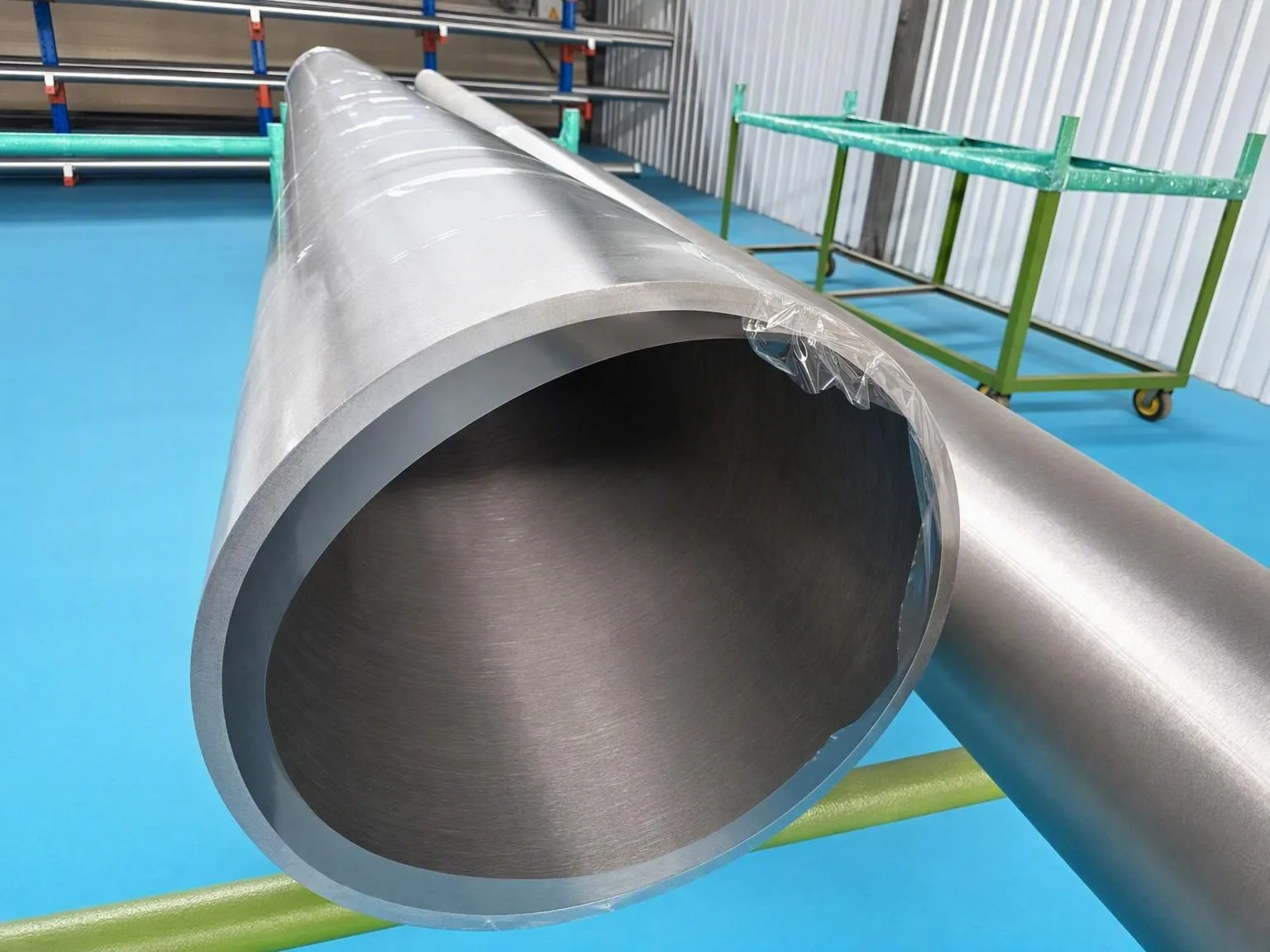
2. Alloy Grade Comparison: Gr1 vs. Gr2 vs. Gr9
Not every exhaust component requires costly high-temperature titanium alloys. Allocating grades based on thermal exposure and mechanical strain optimizes cost without risking failure. Thermal zoning is essential.
| Engineering Parameter | Grade 1 Commercially Pure (Gr1) | Grade 2 Commercially Pure (Gr2) | Grade 9 Near-Alpha Alloy (Gr9 / Ti-3Al-2.5V) |
|---|---|---|---|
| Microstructural Phase | Alpha ($\alpha$) High-Purity Titanium | Alpha ($\alpha$) Commercial Titanium | Near-Alpha ($\text{Near-}\alpha$) Alloyed |
| Tensile Strength ($R_m$) | $\ge 240\text{ MPa}$ | $\ge 345\text{ MPa}$ (Typical 400–480 MPa) | $\ge 620\text{ MPa}$ |
| Yield Strength ($R_{p0.2}$) | $\ge 170\text{ MPa}$ | $\ge 275\text{ MPa}$ | $\ge 483\text{ MPa}$ |
| Elongation at Break ($A$) | $\ge 24%$ (Maximum Ductility) | $\ge 20%$ | $\ge 15%$ |
| Continuous Temp Limit | Approx. 300°C–350°C | Approx. 400°C–450°C | Up to 500°C–550°C |
| Elastic Modulus ($E$) | ~105 GPa | ~105 GPa | ~110 GPa |
| Min Mandrel Bend ($R/D$) | $1.0D–1.2D$ | $1.5D$ (With Bead-Reduced Tube) | $1.5D–2.0D$ (Requires Rigid Wiper Dies) |
| Recommended Section | Formed tailpipes, hand-flared tips | Motorsport Cat-Back Systems, Perforated Cores | Turbo Downpipes, Primary Headers, Up-Pipes |
3. Three Quality Gates for CNC Mandrel Bending
When procurement teams order titanium tubing and precision seamless pipes for CNC rotary draw bending, three metallurgical quality gates must be locked into the purchase order:
1. Internal Bead Reduction and Smooth Internal Contour
Standard welded tubes leave an internal weld seam reinforcement of 0.1 to 0.25 mm. When a thin-wall tube slides over a multi-ball flexible mandrel during rotary draw bending, the protruding weld bead scratches the bronze wiper dies, binds the balls, and triggers localized buckling. Internal flash is hazardous. Certified partner facilities cold-draw welded tubing through specialized floating plugs, reducing the internal bead flush with base wall thickness ($\pm 0.05\text{ mm}$ wall tolerance).
2. High-Vacuum Annealing and Fine Equiaxed Grain Size
Cold drawing induces severe work hardening. Bending cold-worked tubing without adequate heat treatment guarantees brittle splitting along the outer bend radius. Vacuum annealing is critical. Tubing must undergo full recrystallization annealing in a high-vacuum furnace ($\le 10^{-2}\text{ Pa}$) to prevent atmospheric oxygen pick-up. Metallurgical cross-sections must reveal uniform equiaxed alpha grains conforming to ASTM grain size 7 or finer, providing ample plastic reserve during tension.
3. Certified Flattening and Flaring Testing
Every production heat must include mechanical proof testing certified on the accompanying Material Test Certificate (MTC) in accordance with ASTM B338:
- Flattening Test: Samples pressed between parallel plates to distance $H = \frac{(1+e)t}{e + t/D}$ ($e=0.07$ for pure titanium, $e=0.05$ for Gr9) with the weld located at the 90° maximum tension fiber, demonstrating zero cracking.
- Flaring Test: Expanded with a 60° conical tool to achieve at least 15%–20% OD expansion without edge tearing, ensuring safe slip-fit expansion. Test validation is comprehensive.
4. Fabrication Best Practices for Pie-Cut Exhaust Elbows
For tight engine-bay packaging where custom radii are required, fabricators frequently slice straight tubing into $9^\circ$ or $15^\circ$ pie cuts, joining them with multi-pass TIG welds. Manual fabrication is common.
Cutting must be performed with cold circular saws or coolant-lubricated carbide band saws; dry abrasive chop-saws overheat the cut edge, creating an oxygen-contaminated alpha-case zone. Heat build-up must be avoided. Joints and both pipe interior/exterior surfaces within 20 mm must be degreased with acetone or anhydrous ethanol, avoiding bare skin contact prior to welding.
Because titanium absorbs oxygen and nitrogen rapidly above 400°C, the tube must be capped and back-purged with 99.999% argon before striking an arc. Back-purging is mandatory.
- Silver to Light Straw: Exceptional inert gas coverage, preserving full metal purity and fatigue life.
- Deep Gold to Violet: Moderate oxidation with slight reduction in high-temperature fatigue life.
- Grey to Chalky Blue Powder: Severe atmospheric contamination causing brittle embrittlement, requiring complete joint removal and re-welding.
Related Products & Services
- Motorsport and Performance Exhaust Applications
- Industrial Pure Titanium Tubing and Seamless Titanium Pipes
- Grade 9 Titanium Alloy (Ti-3Al-2.5V) Technical Specifications
- Grade 2 Commercially Pure Titanium Technical Specifications
- Small-Batch & Prototype Orders Support
- Certified Partner Facilities Production Lines and Quality Inspection
Complimentary Pre-RFQ Engineering Drawing and Specification Audit
Whether you are ordering 38, 50.8, 63.5, or 76.2 mm thin-wall straight lengths or finalizing tooling bend radii for Grade 9 titanium and Grade 2 commercially pure titanium, contact our technical engineering team. Technical assistance is available.
Submit your exhaust routing drawings or dimensional specifications through our Complimentary Pre-RFQ Audit. We provide rapid custom prototype cut lengths, mandrel bending evaluations, and fully traceable MTC documentation. Technical communication is rigorous.